
Customer-First GEO: How to Build Accountability Into Your AI Search Strategy
Imagine walking into a CMO’s office with this pitch:
We want more budget for a new layer of highly technical marketing work. We can’t reliably attribute it to revenue. We don’t agree on how to measure it. But we know that LLMs tend to reward certain tactics, so we’re going to do more of those things and track whether our visibility improves.
That is, more or less, the GEO pitch right now.
No wonder marketing leaders are skeptical. Most of them have already watched SEO teams spend heavily on technical activity that produced little business value. Now we’re asking them to fund an even less attributable version of the same activity, slapped with a new “GEO” label.
Of course, the GEO industry has an answer: attribution is broken. We have to track a whole group of metrics now. Marketing has changed, and executives may need to accept more ambiguity.
And actually, I agree.
Attribution is broken.
But the real problem isn’t just about attribution. It’s about attribution layered on top of activities that have no clear connection to a customer decision or business outcome.
“LLMs favor Reddit.” → Let’s get on Reddit.
“LLMs extract answers at the passage level.” → Let’s create a thousand FAQs.
“LLMs prefer fresh content.” → Let’s refresh everything.
Our new motto as an industry seems to be:
Here’s what LLMs like.
Okay—but what about our customers? What about the business? At what point do they get a say?
Apparently, after we’re done nerding out.
First, we assemble every activity that might improve LLM visibility. Then we do the CMO a favor and prioritize that list according to projected business outcomes—which, remember, we can’t reliably measure. Then we decide what to execute.
That isn’t a strategy. It’s the organic-search final boss:
All the technical activity. None of the attribution.
And there’s something almost gleeful about how the industry has responded. After years of being challenged to prove the value of technical SEO work, we finally have CMOs where we want them. The channel is important enough that they can’t ignore it, but opaque enough that they have to take our word for it.
“Don’t you want to show up in AI?”
“Wait—you’re asking questions? These CMOs just don’t get it.”
But it doesn’t have to be this way.
The answer is not to chase perfect attribution. Nor is it to stop studying how LLMs work. It is to recognize that the problem is much more foundational.
We’re treating AI like a more complicated search engine, when in fact it’s a human behavioral revolution.
Until we organize GEO around that fact, we will keep treating this revolution like a mega algorithm update—studying what the machine rewards, turning those observations into a list of activities, doing as many as we can, and betting that some of them will lead to business outcomes.
The most mature, durable version of GEO has at least one more evolution ahead of it:
A return to the customer.
The Diffusion Trap: Why We’re Reverse-Engineering the Wrong Thing
To understand where our current GEO mindset comes from, let’s borrow from Everett Rogers’ Diffusion of Innovations model—and Geoffrey Moore’s later concept of the chasm:
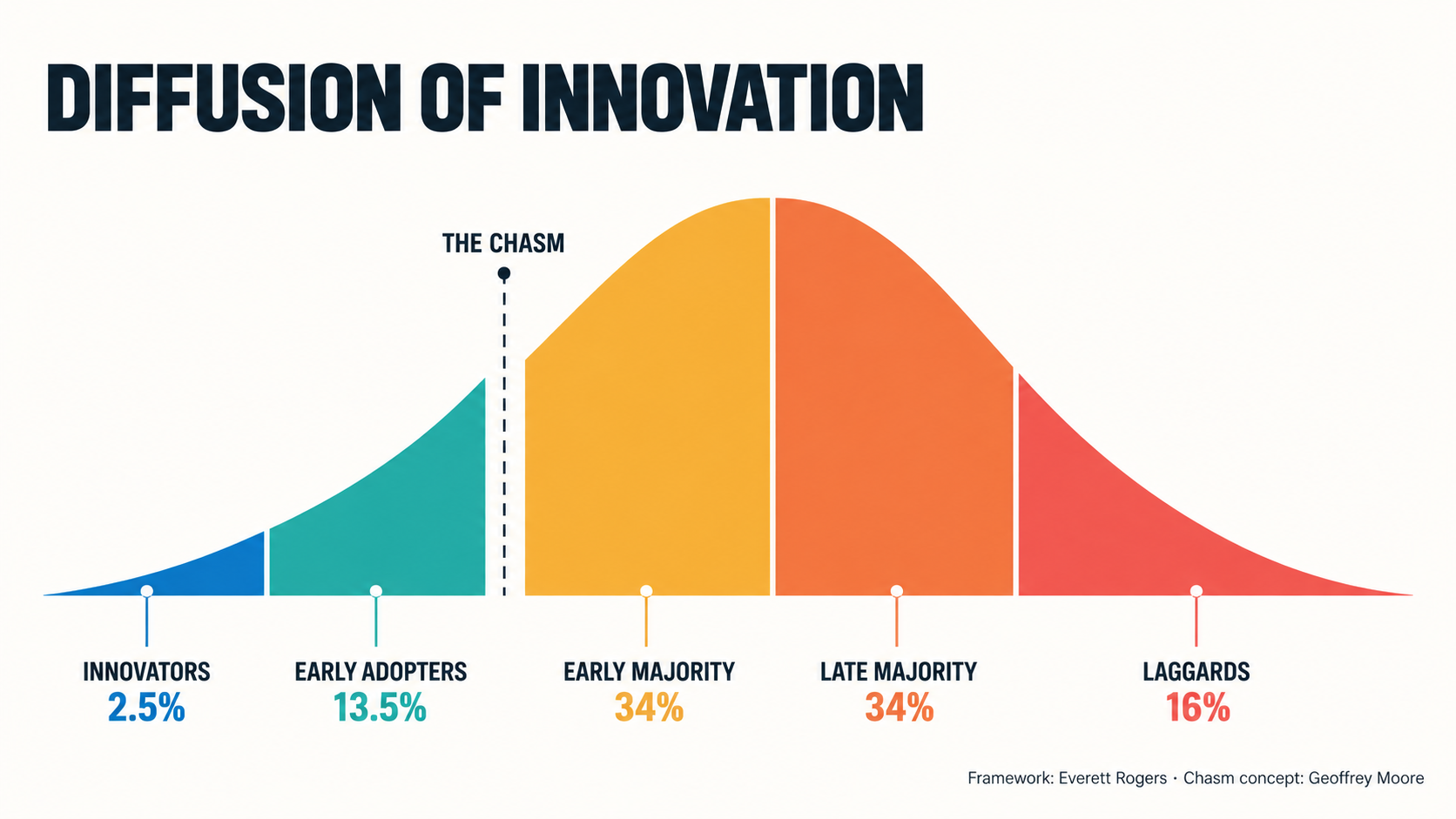
Together, they describe a familiar pattern of adoption and innovation.
To start, a small group of Innovators tests new technologies or ways of doing things for the pure joy and novelty of it. In AEO, these were the hacker SEOs testing llms.txt or spamming Reddit the moment they noticed LLMs citing forum threads.
Then, the Early Adopters take those experiments and turn them into products that have commercial value. These were the agencies turning tactics into case studies. Now they’re “visionaries” and get the cachet along with it.
Next, the Early Majority comes along, demanding certainty and reliability:
- "Tell us how big our AI opportunity is"
- "How do we measure this?"
- "What ROI will I get?"
(Sound familiar?)
Right now, the industry is stuck in the chasm. Service providers are trying to sell the Early Majority on speculative, technology-first tactics developed by Early Adopters. The Early Majority hesitates and asks questions the Early Adopters don’t know how to answer.
Notice how each step builds on the last:
- Innovators ask: What can I make this thing do?
- Early Adopters ask: Which of those discoveries creates business value?
- The Early Majority asks: Which of those business applications are reliable, measurable, and safe enough to fund?
That sequence makes intuitive sense. Someone has to play with the new thing before anyone can commercialize it. Someone has to commercialize it before the average company will trust it.
But the Diffusion of Innovations doesn’t tell us what to innovate; it just tells us how the innovation happens. So if the Innovators build on the wrong thing, every step after follows the same pattern.
For GEO, we took a technology-first approach to innovation: how can we hack this algorithm?
For other platforms, innovation can start in a different place.
Take TikTok, for example.
No one cares about hacking the technical backend of TikTok. Sure, hashtags are a thing, but they don’t really determine who makes big money.
Instead, innovation on TikTok looks like this:
- What can I make this thing do? Create videos. Invoke emotion. Get validation from strangers.
- Which of these creates business value? Use emotion to build affiliation. Use affiliation to build tribes. Center those tribes around a product.
- Which of these are reliable, measurable, and safe? Pay tribe leaders to sell our products. Ideally pay them on commission.
GEO and TikTok started their innovation in different places, so they got different outcomes.
Now let’s play a game and invert the roles:
Pretend you wake up tomorrow and visibility on TikTok depends 100% on keyword density. You still have to make videos, but your success hinges on saying "best running shoes" followed by “shoes that are best for running” and a million other variants.
Sounds absurd, right? Why? Because it changes the fundamental nature of the platform.
But that’s what AI has done to search.
The Two Big Changes of the AI Era
The arrival of generative AI brought two societal changes:
The first was technological. Search engines and LLMs are not the same thing. They’re different at a code level and use different hardware. We see developers mass-migrating to AI careers, and experience GPU and RAM shortages as companies gobble up parts to build data centers.
On the SEO side, strategists are thrown into a frenzy trying to optimize for the new technology.
Fortunately, SEOs have a history with this kind of problem. The new black box is way more complex than what we’re used to, but we’ve spent decades reverse-engineering complex black boxes.
If we had to map how our behavior has changed to adapt to AEO, it’d probably look something like this:
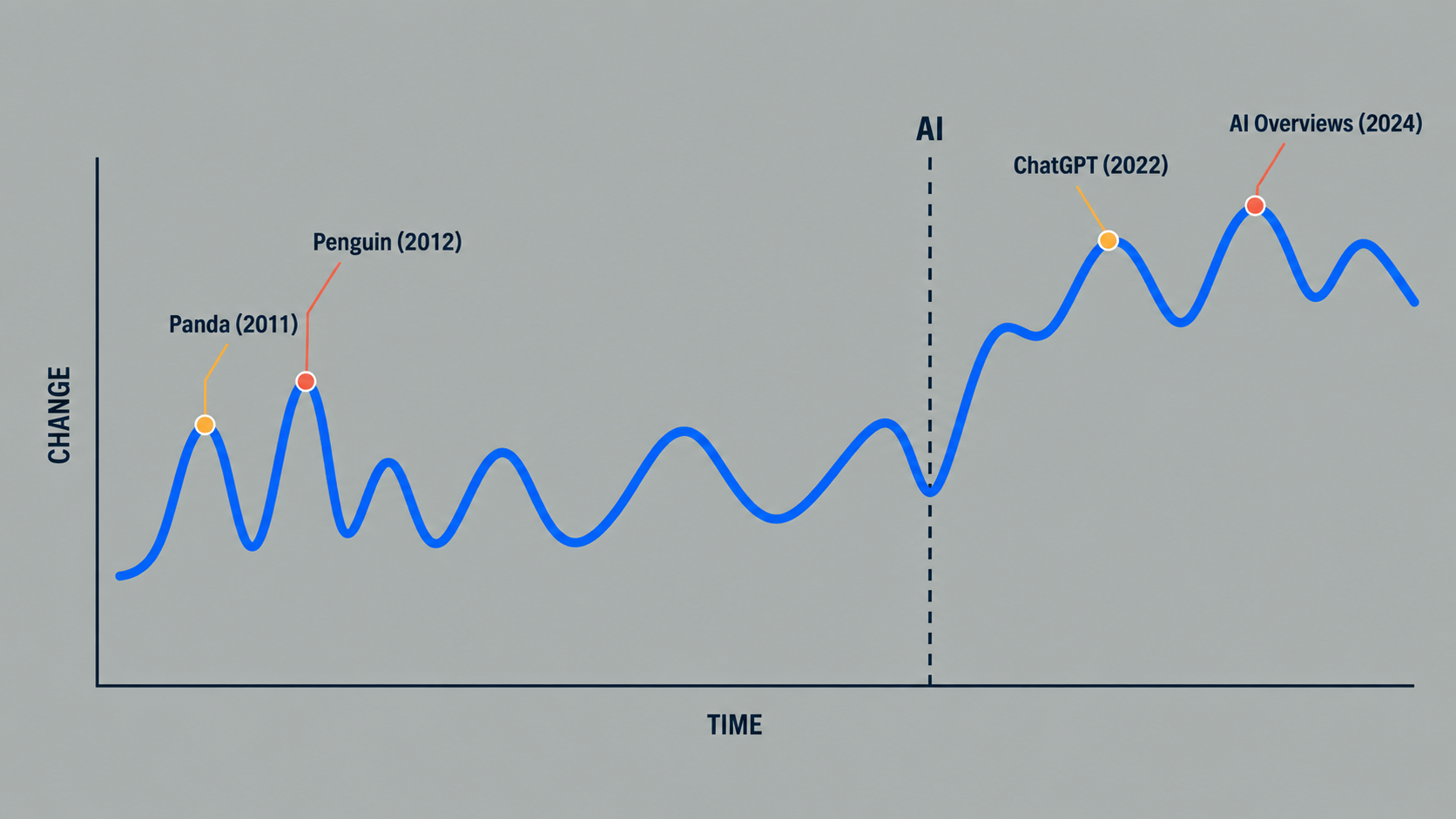
AI changed the difficulty by an order of magnitude, sure, but we’re still just reverse-engineering the technology. Previous algorithm updates have made our industry feel roughly the same way. And we’re still using the same building blocks we always have: links, content, and features in third-party publications.
Compare the technological change to the change in human behavior:
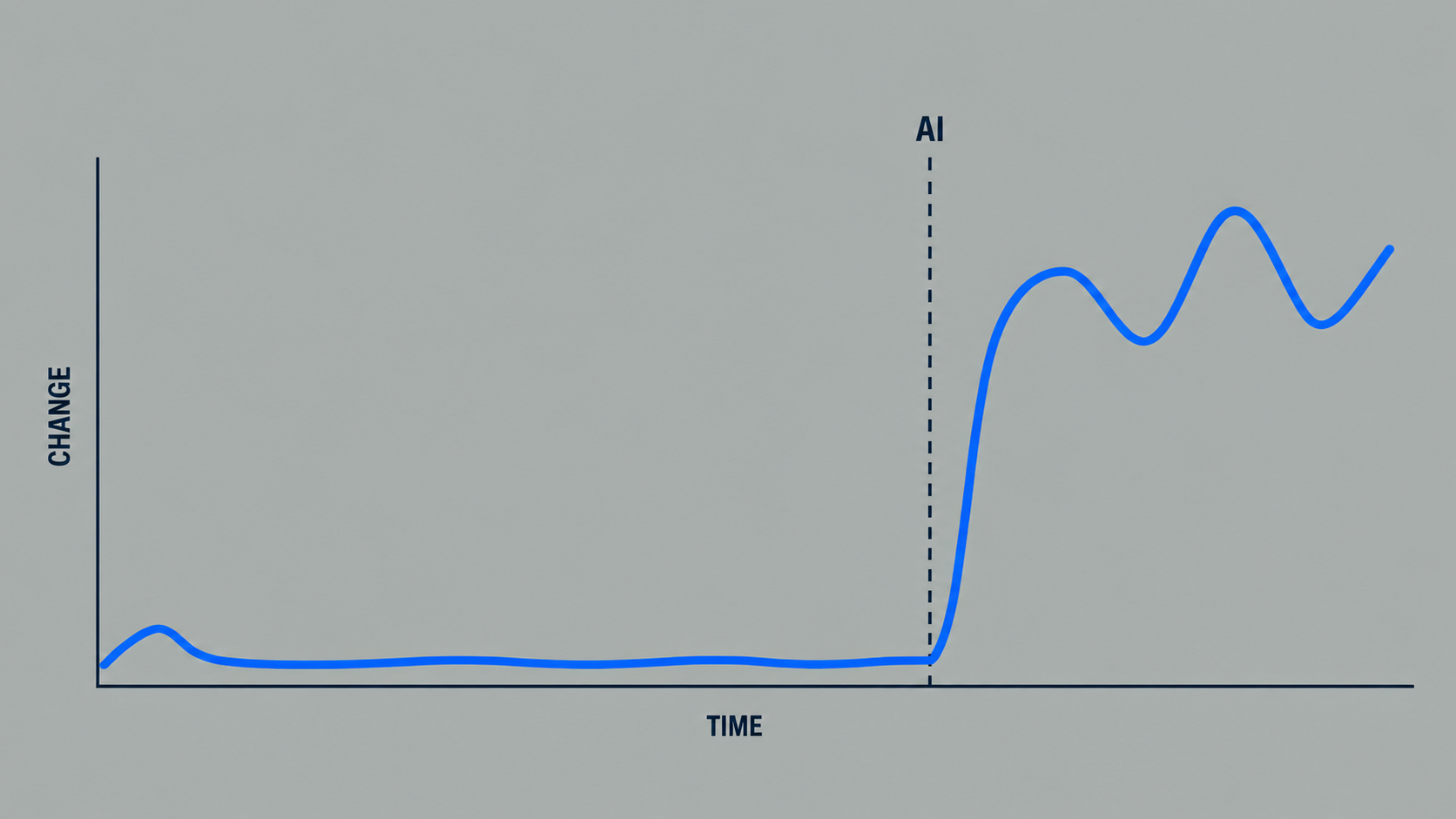
For roughly two decades, people adapted themselves to search engines. There was a little blip at the beginning when people learned to type compressed phrases like "best running shoes." After that, their basic behavior remained stable: enter a query, inspect links, exercise judgment, and take action.
Then AI happened.
I probably don’t need to elaborate on the basics of how people can use AI. If you’re reading this, you’re an Early Adopter and I’m preaching to the choir.
The question I’m interested in is whether our behavior has matched this observed reality.
Quick test:
If I looked at your SEO budget and calendars over the last year—the only objective measurements of priority – would your investment in customer research look like this?
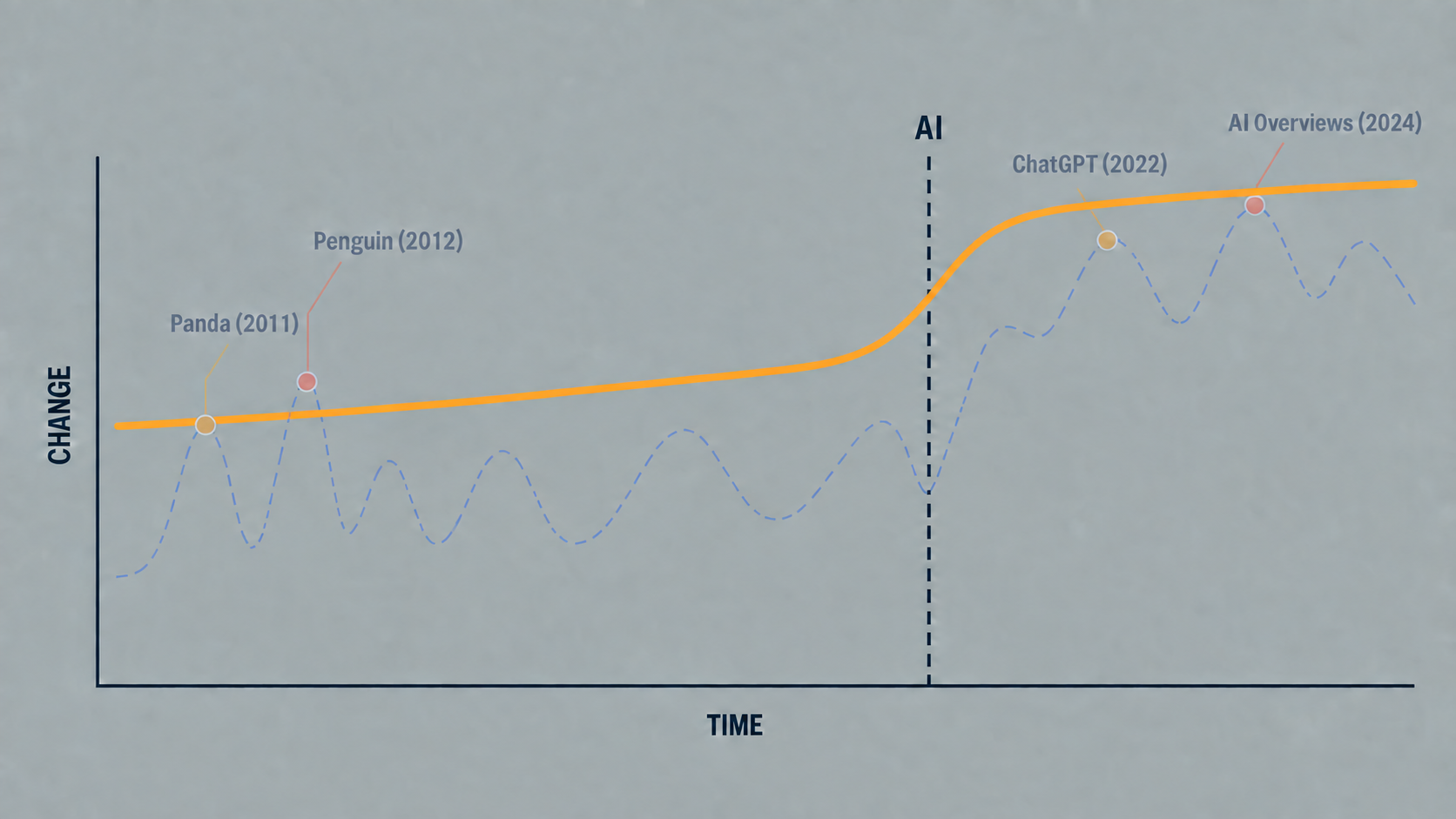
“Increasing a decent amount, but still kind of doing the same things we’ve always done.”
Or this?
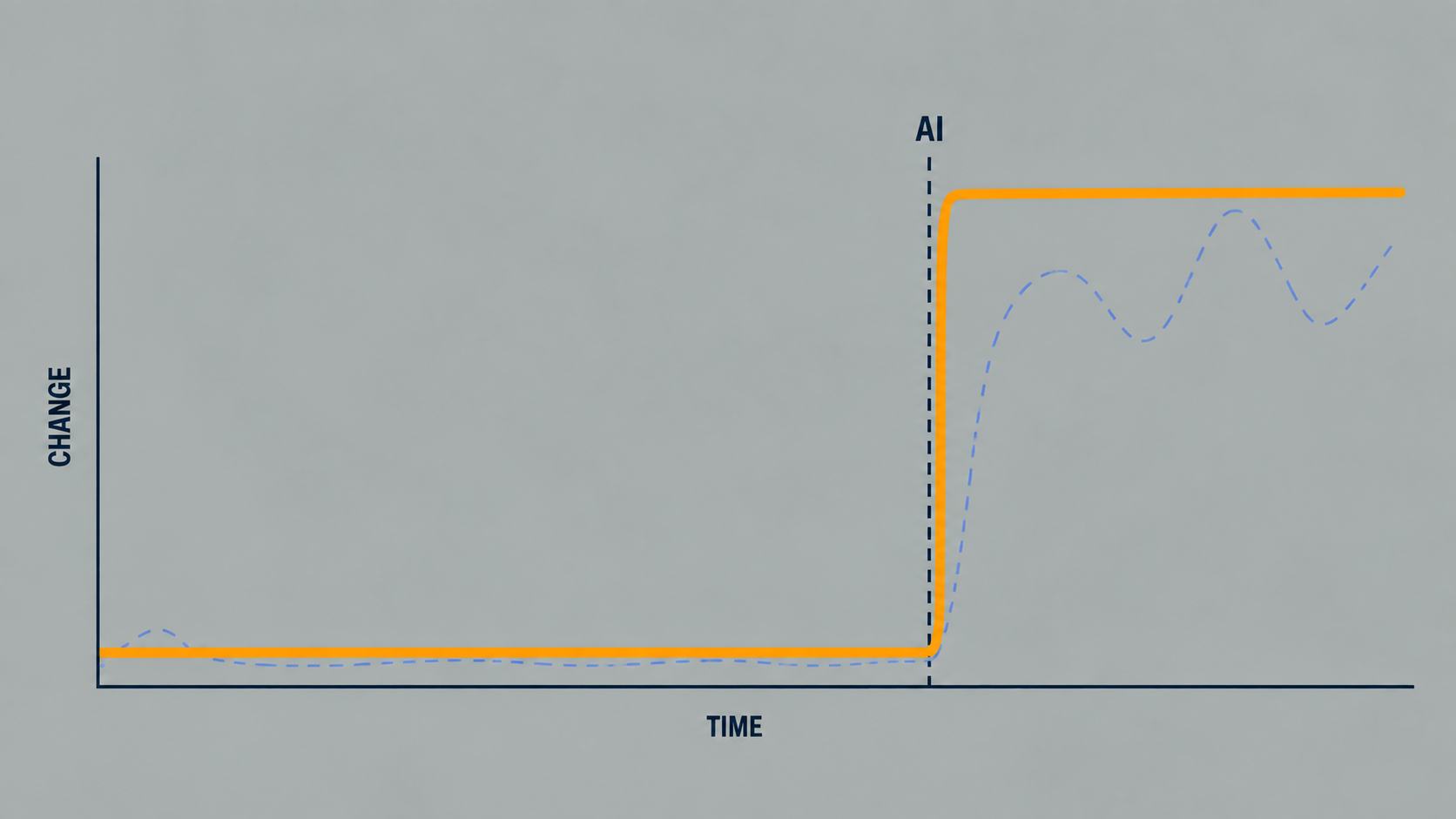
“The amount of customer research we’re doing now dwarfs our previous efforts. Not only has the amount of work shifted, but we’re approaching it in completely different ways.”
My observations point to the former. Our customer research improvements are incremental.
We see it in our GEO tools—prompts are the input. But where do the prompts come from? Same customer research we’ve always been doing.
We see it on LinkedIn. The people talking about customer research now are the same people talking about it five years ago. Only now they’re starting to sound self-congratulatory. “We’ve always been focused on customer research, so now we’re ahead of the curve.”
But notice the break in logic.
If this is reality:
And you’re doing approximately the same kind of customer research you always have, then either the work you were doing before was excessive, or now it’s not enough.
Which is it? My experience says what we’re doing is not enough.
For example, I was talking to some friends in the SEO/GEO space who I admire specifically for their focus on customer research the other day. I mentioned how customer behavior has changed. When I asked how they were adapting, they said something along the lines of:
“Well, we’re already interviewing our clients, talking to sales leaders, reading all the reviews, so we’re kind of good to go in that area.”
But notice where that narrative leads:
“We already do customer research…. So we’re good to go in that area… Now all we need to do is figure out the technology.”
Back at technology-first.
And that’s the trap. The people best poised to lead us into the future are the ones with their heads buried in the sand. Their identities are built around being “the customer-research people,” so it never occurs to them that they’re underprepared in that area.
That leaves us with the question:
“If our current strategy isn’t enough, what is required? What would a true adaptation look like?”
Fortunately, we have an example. And a recent one.
An Example of Adaptation: Meta Ads and Andromeda
In 2015, winning on Meta was largely a technical media-buying problem. The nerd behind the dashboard set up the pixel, built detailed audiences, created lookalikes, and adjusted the targeting until the ads reached exactly the right people. Of course, the creative was still part of the equation, but the technical setup had an outsized effect.
Set up the machinery correctly and your ROI could change overnight.
Then Apple introduced App Tracking Transparency, and limited the data Meta could collect. Over the next several years, Meta responded by automating more of the targeting work. That transition culminated in Andromeda, an AI-powered retrieval system designed to match ad creative with the people most likely to respond.
The pixel still mattered, but the balance between technical and creative work inverted.
Now advertisers simply gave Meta creative assets and let Andromeda do the targeting. If your image, copy, story, and offer resonated with the right people, Meta could find more of them. If not, you'd set cash on fire.
In essence, the creative became the targeting.
This created a new problem: the machine needed far more creative assets than most teams were producing—and more variety. Different hooks. Different formats. Different stories, images, emotions, and offers.
For a long time, folks couldn't keep up. They’d increase their output by 10% or 20% and wonder why they weren’t getting an ROI. Cue lots of Twitter posts about Facebook performance falling off a cliff.
But eventually, the entire industry reorganized.
Companies built new workflows and shifted budgets. They assembled entire teams around creative production and testing. The people responsible for running those systems became known as creative strategists.
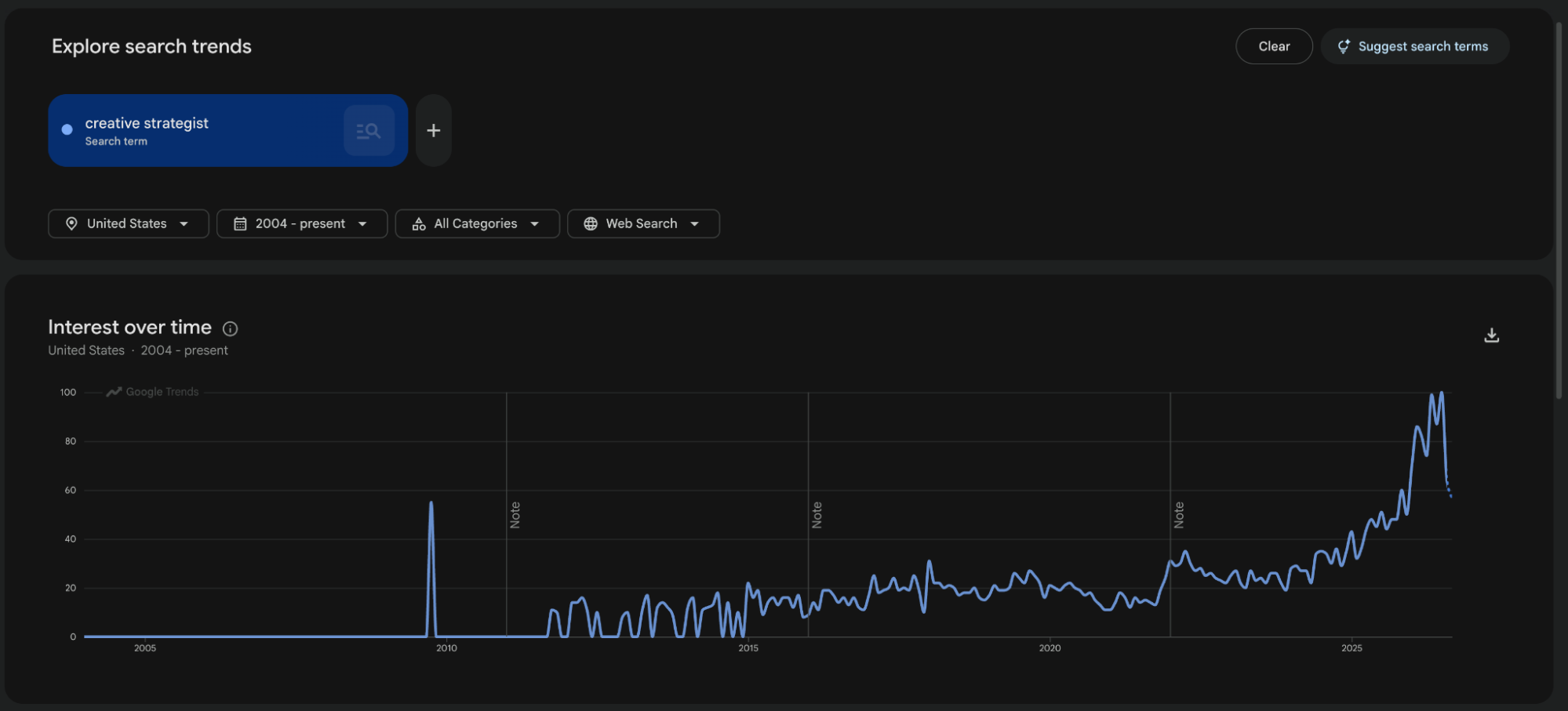
Notice when the trend takes off: late 2024 and early 2025.
In short, the shift looked like this:
Before: Most of the work happened behind the scenes—adjusting pixels, audiences, and targeting. Creative mattered, but it was just one input.
After: Technical setup still mattered, but the bulk of the work shifted to creative.
That is what real adaptation looks like.
New roles. New workflows. New budgets. New tools. A different organizing principle for the entire function.
GEO Has No Forcing Function
The paid-social industry made this transition quickly because it didn’t have much of a choice.
The old targeting levers lost enough of their power that advertisers had to find other sources of advantage. Teams that continued relying on the old playbook watched performance suffer until they adapted.
GEO is different.
Technical GEO still matters. Content still matters. Links and third-party coverage still matter. Studying which pages LLMs retrieve and which sources they cite can produce real competitive advantages.
That sounds like good news, and in some ways, it is.
But it also means nothing is stopping us from creating SEO V2: The Even Worse Edition for the people investing in our services. Endless technical activity. No accountability. Just roll the dice and hope your agency gets lucky.
If you think SEO’s reputation is sketchy now, let's see where we are in five years.
So How Do We Adapt to GEO?
Post-Andromeda advertising teams had to produce dramatically more creative to adapt. From my research, they needed to boost output by at least 10x (that's 1000%). And quite frankly, I think the transition from SEO to AEO is even more severe. Facebook users didn’t fundamentally change how they used the platform , but search users did.
So let’s use 100x as a thought experiment.
If we had to spend 100x on customer research and make it make sense from a business perspective, what would that look like?
Let's talk about the 1x version to orient ourselves. We all know what questions we want to answer:
- How are our customers actually using AI? Which tools? Chat or coding agents? Are they building things or asking questions?
- What language do they use? What do customers explicitly mention, and what exact words do they use?
- What does the AI consider automatically? What criteria does AI evaluate even if the user doesn't suggest them?
The 1x version is whatever you're doing today. If you're like most customer-oriented folks, that includes doing any amount of research that does not involve actually talking to customers (if you’re an agency, that means your customers’ customers). That might mean reading reviews and transcripts or listening to calls.
10x is actually talking to customers—continuously interviewing them and adjusting your strategy based on what you find.
100x could be something like this:
Imagine you open Ahrefs. But instead of every number coming from aggregate search behavior, they come directly from your customer assets.

What if the first tab isn’t Keywords Explorer. It’s Customer Explorer.
We take all of your company’s sales calls, reviews, support tickets, surveys, interviews, and CRM notes and ask:
"How many customers brought up this same concern?" This gives you customer volume instead of keyword volume.
Instead of CPC, you'd have customer value. Which concerns correlate with your largest deals, highest average order values, strongest retention, or greatest lifetime value?
Instead of keyword difficulty, you have influence difficulty. When customers bring a concern to AI, which sources shape the answer? Can you update the information directly, or do you need to earn your way into a publication?
Instead of rank tracking, you have customer visibility. How often does your brand appear in AI for the concerns that matter most to your customers?
Notice how everything shifts.
This system cannot tell you how many people in the world search for a particular phrase. It cannot give you traditional keyword volume.
Instead, it puts the customer at the center of the evaluation.
Instead of beginning with search volume and backing into customer value, we begin with customer value and work backward to the technical specifics.
In a world where every AI conversation is becoming increasingly contextual—and every prompt is moving closer to one of one—I believe this will become the only reliable starting point.
This approach also inverts how we prioritize work.
Suppose two concerns appear equally important to our best customers.
For the first, the AI’s answer is shaped by 75 major publications where we currently have no presence. Influencing it will require a long, expensive campaign involving PR, partnerships, and third-party coverage.
For the second, the AI is already pulling heavily from first-party sources. The missing information simply isn't explained clearly enough on our website.
This second opportunity is much easier to influence and is where we should spend our time.
Notice how the prioritization has inverted:
- Before: Which technical opportunities exist → which are high intent → which are valuable to our customers?
- After: Which concerns matter to our customers → which are associated with higher deal value → which are technically feasible?
Customer research stops being something we layer onto a strategy and becomes the system that selects the opportunity.
That is the difference between conducting more research and reorganizing GEO around customer intelligence.
It also solves one of the oldest problems in customer research.
We all know how this usually goes. Someone conducts the interviews, pulls together the themes, creates a thoughtful presentation, and inspires a campaign or two. Six months later, the deck is sitting untouched in a shared drive.
Doing 10x more research doesn’t solve anything if it just produces 10x more slides.
The 100x prevents that by breaking qualitative insights down into data we can use to make strategic decisions.
Now, turning 50 sales calls into trustworthy data isn’t easy. But it is a solvable problem
More importantly, it is exactly the kind of problem AI can now help us solve.
And consider what the GEO industry has already accomplished. A few years ago, understanding what went on under the hood of ChatGPT sounded impossible. Then we poured talent, money, experimentation, and technology into figuring it out. What would customer intelligence look like today if it had received the same investment?
That is the question behind High Command.
At its core, we're building software to turn customer assets into structured concerns, customer-grounded prompts, AI visibility analysis, and prioritized opportunities. Unlike other GEO tools that ask, “What prompts should we track?” High Command helps you answer “What are my customers searching for?”
This helps answer question #2: “What language do they really use?” But it still needs to be complemented by research and analysis that address questions 1 and 3:
1. How are our customers actually using AI?
3. What does the AI consider automatically?
You need all three to truly 100x your customer intelligence—and to walk back into the CMO’s office with a strategy you can stand behind.
Back to the CMO’s Office
Imagine walking back into the CMO's office with a different pitch:
Seven of your ten highest-value customers have these same five concerns. Here’s the exact language they used to describe them.
When we tested that language in AI, your two largest competitors were recommended far more frequently. These are the specific gaps preventing you from appearing.
We propose closing those gaps, measuring whether your recommendation rate and source coverage change, and tracking whether the same concerns continue to appear in your pipeline.
Notice how the conversation has shifted:
Attribution still isn’t perfect, but the dynamic has changed:
The CMO is no longer being asked to fund a list of activities because the technology says they're important. The company is deciding which customer concerns matter enough to focus on, and funding the work required to influence them.
That creates a defensible chain even when attribution is ambiguous:
valuable customer concern → AI behavior → strategic gap → intervention → visibility outcome
The eventual tactics may still look familiar. But the way we've approached the problem has changed the strategy and conversation.
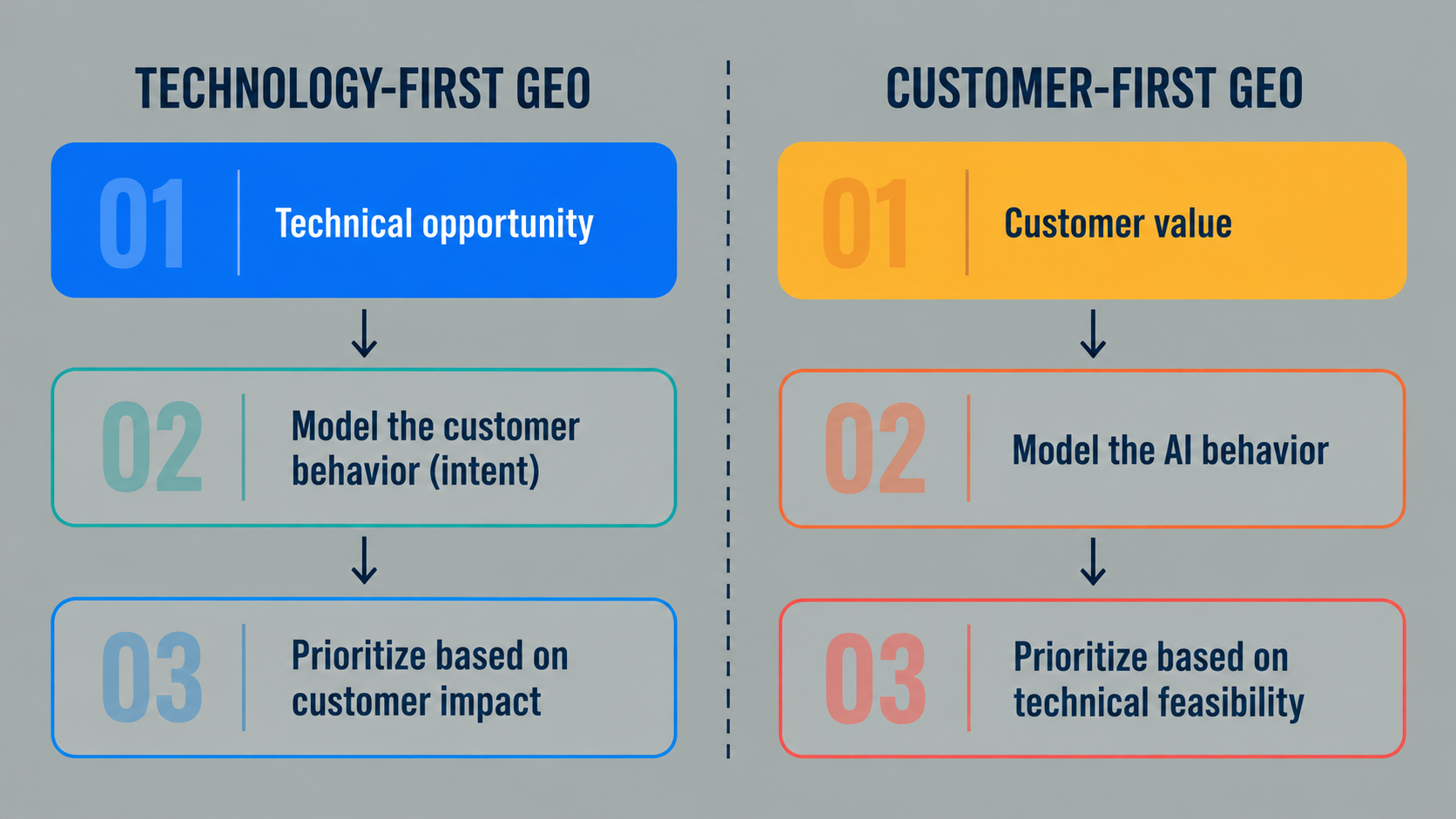
Technology-First GEO:
Technical opportunity
↓
Model the customer behavior (intent)
↓
Prioritize based on customer impact
Customer-First GEO:
Customer value
↓
Model the AI behavior
↓
Prioritize based on technical feasibility
That is the difference between Technology-First GEO and Customer-First GEO.
The alternative isn’t less experimentation, less technical rigor, or less ambition.
It is applying those qualities to the part of the AI transition we have underinvested in from the beginning:
The customer.
Notes on AEO, SEO, and getting more of your best customers from AI search. No spam.
Member discussion