
Battleground SEO
A step-by-step guide to reverse-engineering topical authority, ranking for your most competitive keywords, and beating the most powerful competitors in your space… without having to spend a fortune on backlinks or technical SEO.
If you pay attention to your Google searches, you’ll probably see small, unknown competitors occasionally outranking huge companies like Amazon.
For example, at time of writing if you search “Colombian coffee” you’ll see colombiancoffee.us and several other smaller coffee companies outranking Amazon:
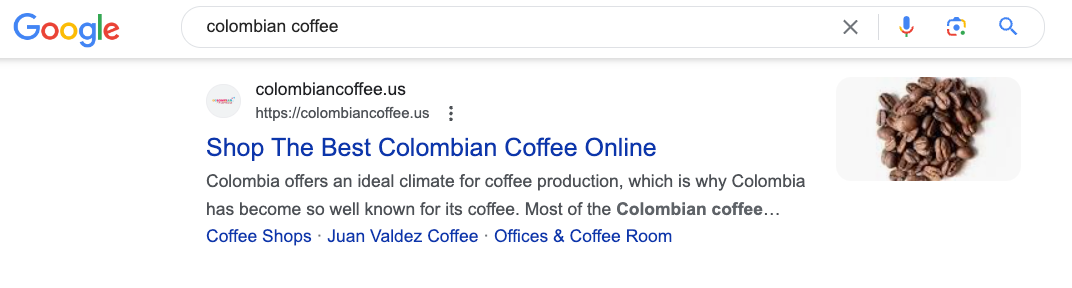
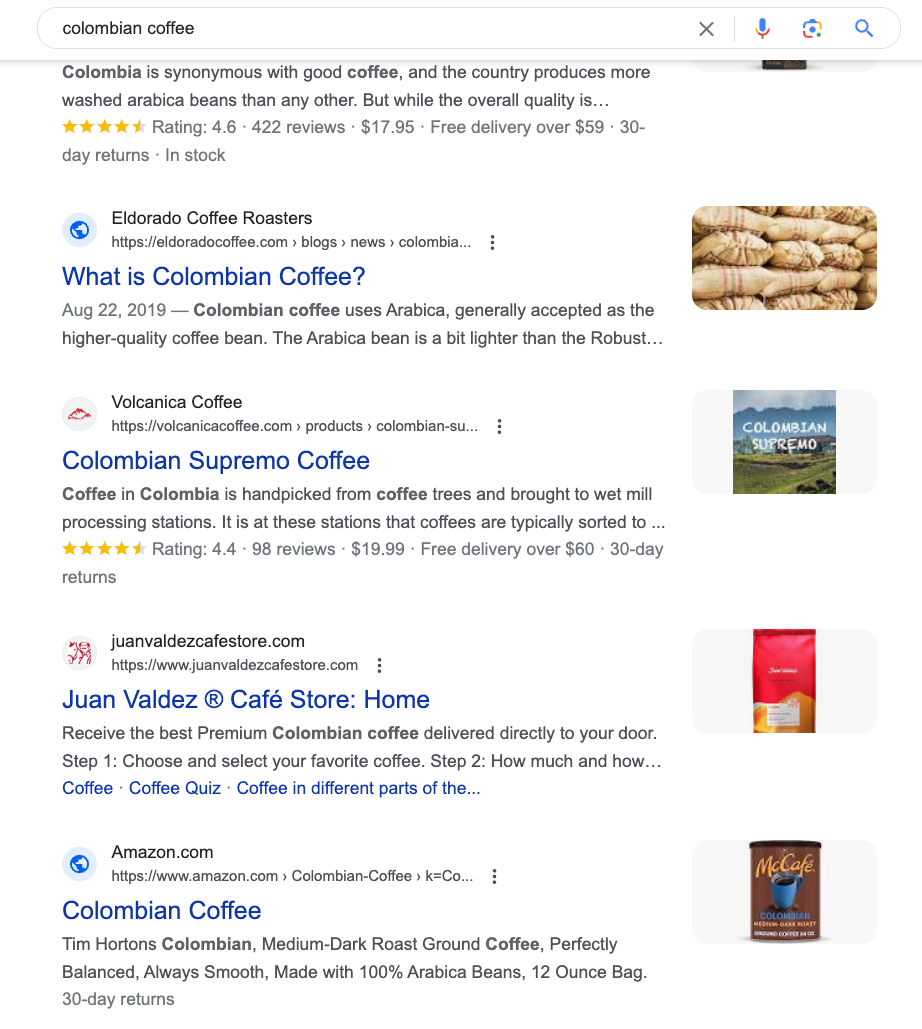
All this despite Amazon’s many advantages:
- More resources and employees
- More and better backlinks
- Wider selection of colombian coffees
- Better brand awareness, which increases click-through rate
- A better UX (hello, one-click ordering!)
- And more
How does this happen?
SEO geeks would say the smaller sites are outranking Amazon due to “topical authority”. In other words, Google’s algorithm thinks colombiancoffee.us is more of an expert on the topic of Colombian coffee.
This does make sense if you look at colombiancoffee.us for a minute. It features content about Colombian coffee, explanations of the various types, and lots of relevant products. Look at the domain for goodness sake — the concept of Colombian coffee oozes out of the site's DNA.
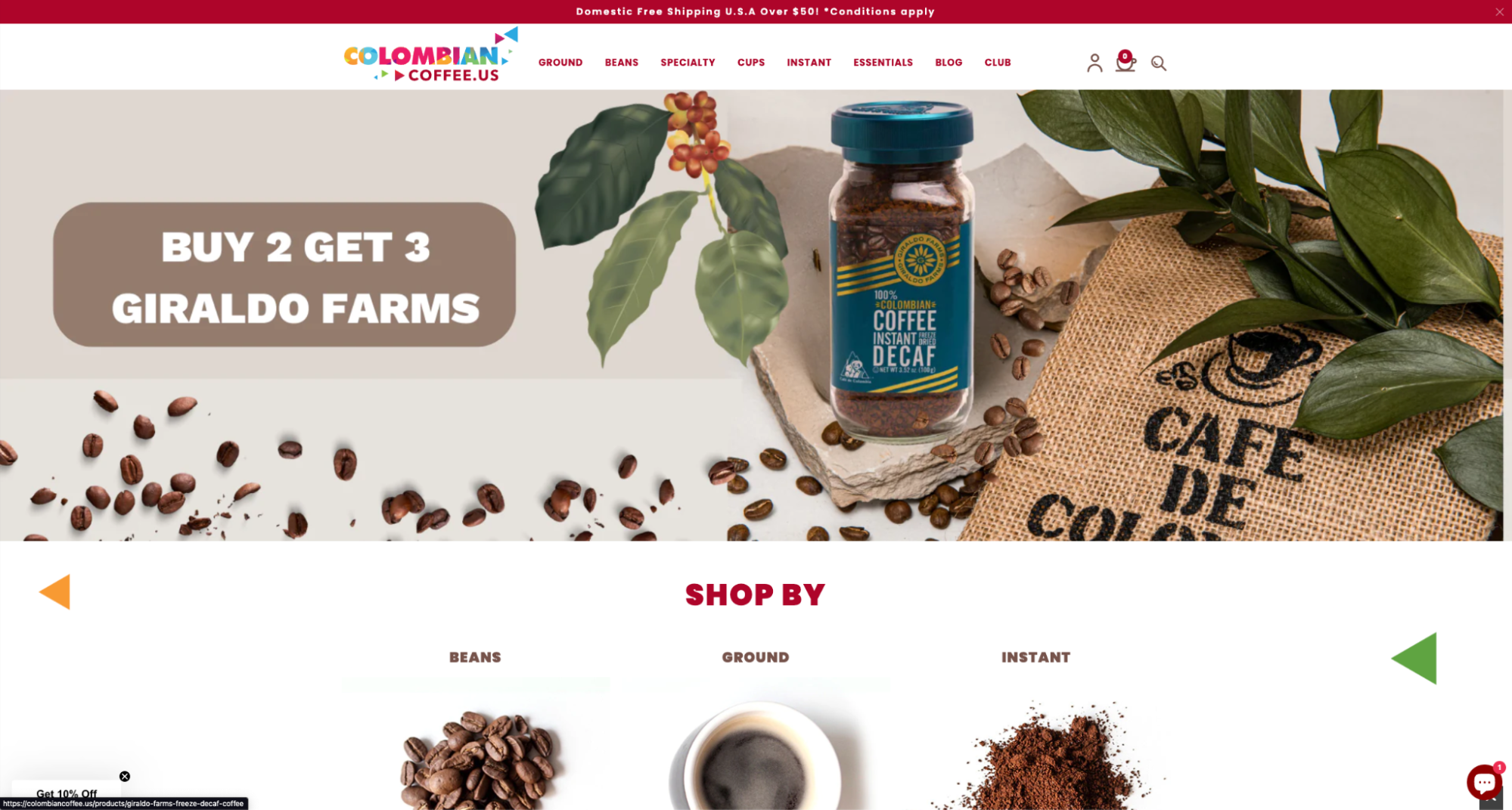
Essentially, buying from colombiancoffee.us is like buying from a small local boutique run by a coffee nerd. Compare that to a local Amazon equivalent — say, Walmart. Walmart probably has more products with “colombian roast” on the label, and for better prices. But which do you think offers the best coffee or a better coffee-buyingexperience? Probably the small shop, right?
Same deal here. Topical authority allows you to position your site as an expert without a huge brand. For that reason, it’s all the rage in SEO circles right now. It allows smaller, less well known sites to outrank larger, more powerful competitors. And it happens all the time.
The only problem with topical authority is no one knows how to reliably recreate it. Everyone knows it involves creating a bunch of content around one central topic, but that’s pretty much it. All the guides on the topic are vague, hand-wavey, and include a bunch of guessing and conjecture.
For example, check out these guides from SEO industry titans Ahrefs and Search Engine
Journal (SEJ).
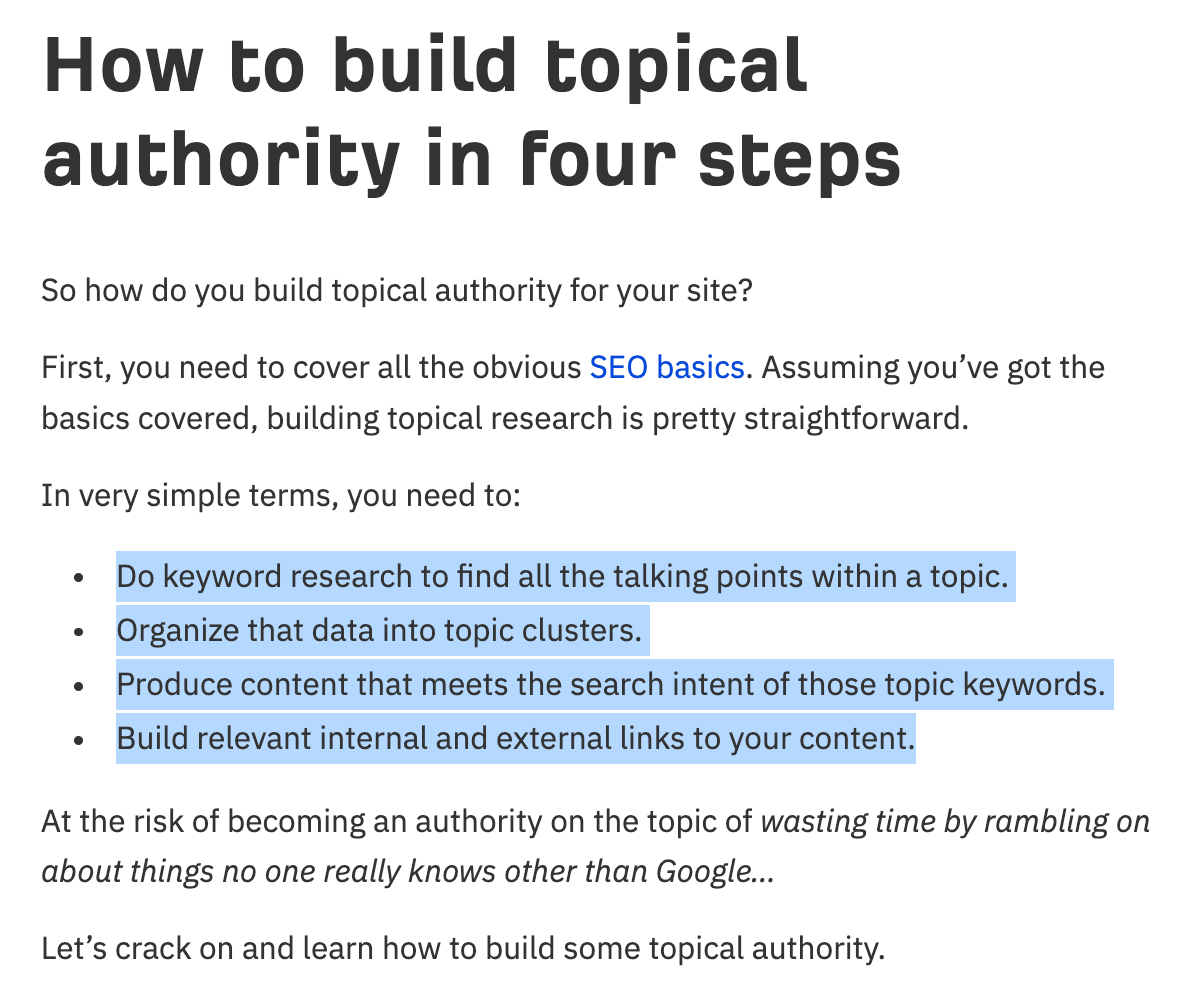
Ahrefs essentially says “Do keyword research, organize the keywords into clusters, write content, then build links.”
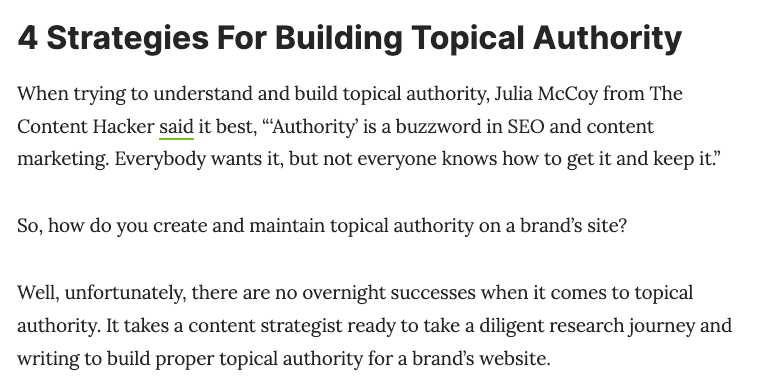
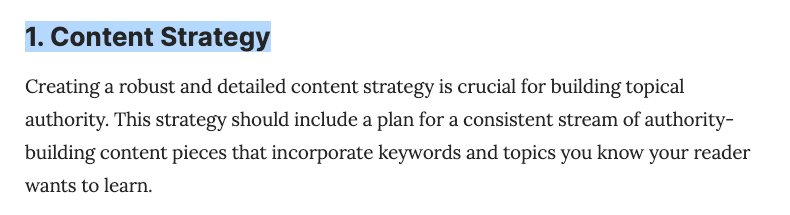
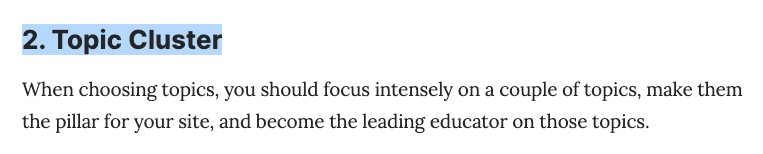

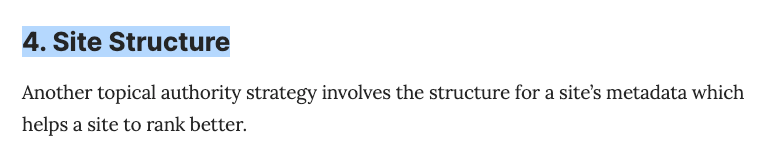
Search Engine Journal says topical authority is about “content strategy, topic clusters, user intent, and site structure”.
Of course these are high level overviews, but the full-length content isn’t much better. Not exactly helpful.
I don’t say this to take shots at Ahrefs and SEJ, but to point out that this is an industry-wide problem. These are well-respected sources of SEO information, and they’re still vague and — to put it bluntly — unhelpful.
Battleground SEO is my solution to this ambiguity. In short, Battleground SEO is a step-by-step process to help you:
- build topical authority
- rank for your most competitive keywords
- beat the most powerful competitors in your space
All without having to spend a fortune on backlinks.
In this article I’m going to lay out the full process for Battleground SEO. This post isn’t just theory or vague advice. I’ll show you the exact tools I use, how I use them, and what kind of results they’ve helped us get for our clients at Meriwether.
How Battleground SEO Came to Be
Battleground SEO started with a unique client experience (client’s identity hidden for privacy, but I’ll show you some case studies later).
Specifically, I had an old client come back a year after we’d parted ways and say,
“Hey, not sure what you did, but we just had our best year in SEO and business in a decade. Want to work together again?
That was obviously great to hear, but I wasn’t sure what we’d done to create those wins. I’d done some great work for them, but nothing that would change their business to this extent.
Then I dug into the data and had four specific realizations:
- The client started ranking #1 for the most valuable term in their industry just a month or two after we parted ways. Think ranking a mom and pop shop for “diamond ring.”
- We didn’t modify the page that was ranking for said term. At all. All we did was publish a handful of blog posts on adjacent topics.
- We saw a direct correlation between the performance of two blog posts and rankings for one high-difficulty keyword. Specifically, the blogs were updated and saw an immediate spike in traffic and rankings. Then, a collections page started ranking better for a relevant — but adjacent — high-difficulty keyword. Immediately after the posts were published. None of my previous tests offered this level of precision.
- The client had another nearly identical site in the same space that was not ranking for the same keywords. It had a similar DR, product catalog and overall SEO profile. The only way it differed was in content. They hadn’t published on this new site as regularly or recently.
These points were enough to get started. For weeks I dug into this client’s SEO history. Which direction did the data point? What happened?
Now, I won’t get into the minutiae of what I found or when. But I will say that this process and experience is what led to the first iteration of what I call Battleground SEO today.
I took what I found with this client, reverse-engineered it into a system, and tested it on another client that had recently dropped rankings for their #1 keyword. Here’s the result:
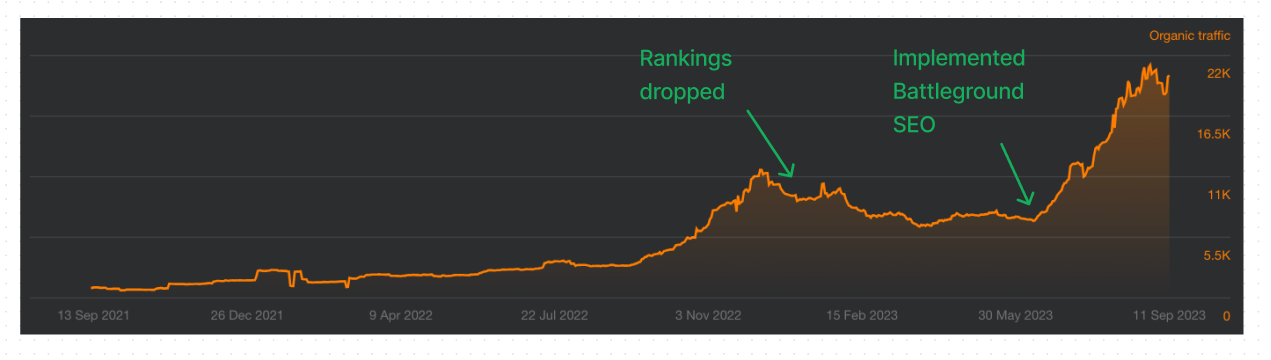
After implementation, their rankings were back within weeks, and the site continues to grow across that entire category.
The process I used is the process you’re going to read about below.
The Process
The number one key to topical authority is:
“Google leaves clues, you just have to follow them.”
What are the clues? I call them associated keywords. What are associated keywords? Keywords a page ranks for, but badly.
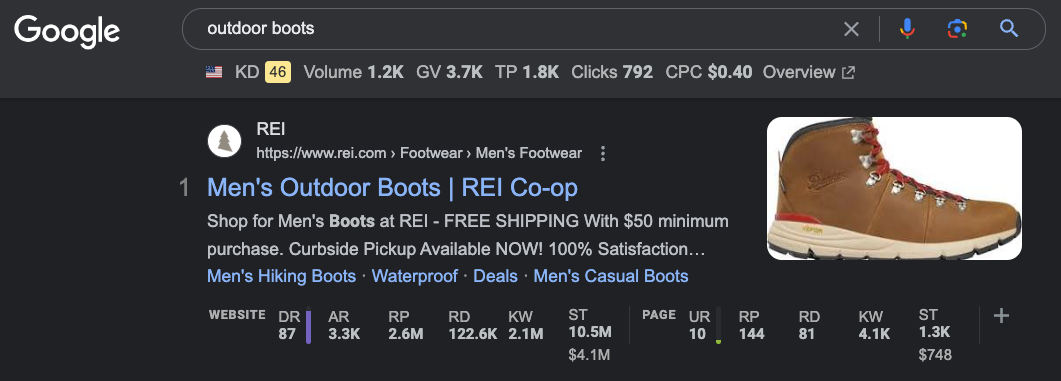
For example, this page from REI ranks number 1 for “outdoor boots”:
It also ranks #89 for “danner steel toe boots”:
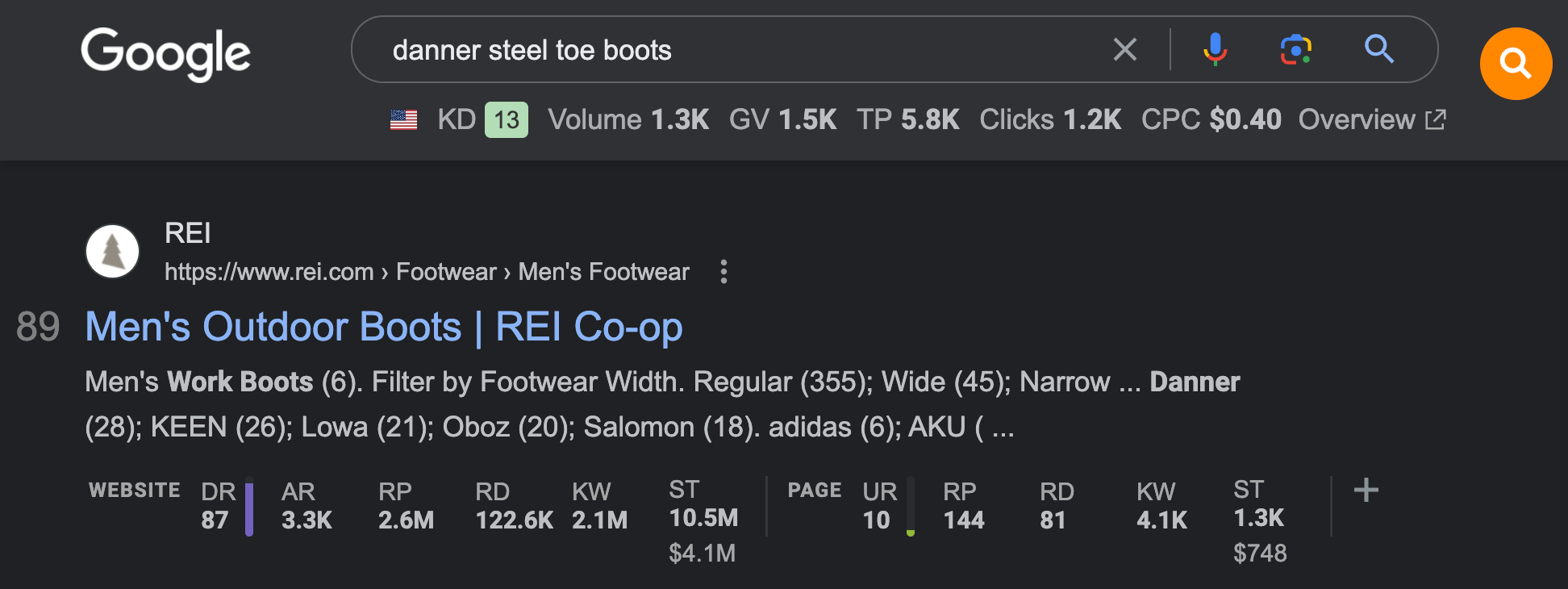
It'll never rank #1 for “danner steel toe boots” because it's just not relevant. Danner.com rightly dominates the top positions for that keyword.
However, the ranking still implies some sort of connection. I call this connection an “association.” In other words, I’d say REI’s page is associated with (not “ranking for”) “danner steel toe boots.”
Now, noticing one associated keyword isn’t all that helpful. But, if you can find patterns of associated keywords across multiple sites or pages, they become incredibly powerful.
For example, here are the four top-ranked pages for “outdoor boots” at time of writing:
- https://www.rei.com/c/mens-boots
- https://www.rockyboots.com/rocky/mens/footwear/outdoor/
- https://www.amazon.com/Outdoor-Boots/s?k=Outdoor+Boots
- https://www.switchbacktravel.com/best-hiking-boots
If we plug these four pages into Ahrefs’s content gap tool (more on this later), you can see that all four are also associated with “outdoor gear boots”:
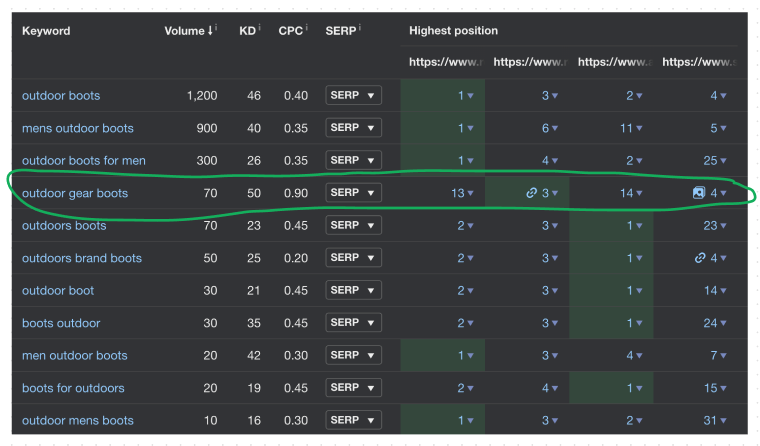
This is a pattern you’ll see often. Pages that perform well for one keyword — “outdoor boots” in this case — often share associated keywords.
They will also have many unique associated keywords. For example, only REI is associated with “mens boots” at position 65.

This is the case in every SERP. Some keywords are associated with all of the top-ranking pages, some with only one or two, others with three, four, or none.
We can visualize these relationships by mapping them to a knowledge graph — a graphical representation of information, or knowledge:
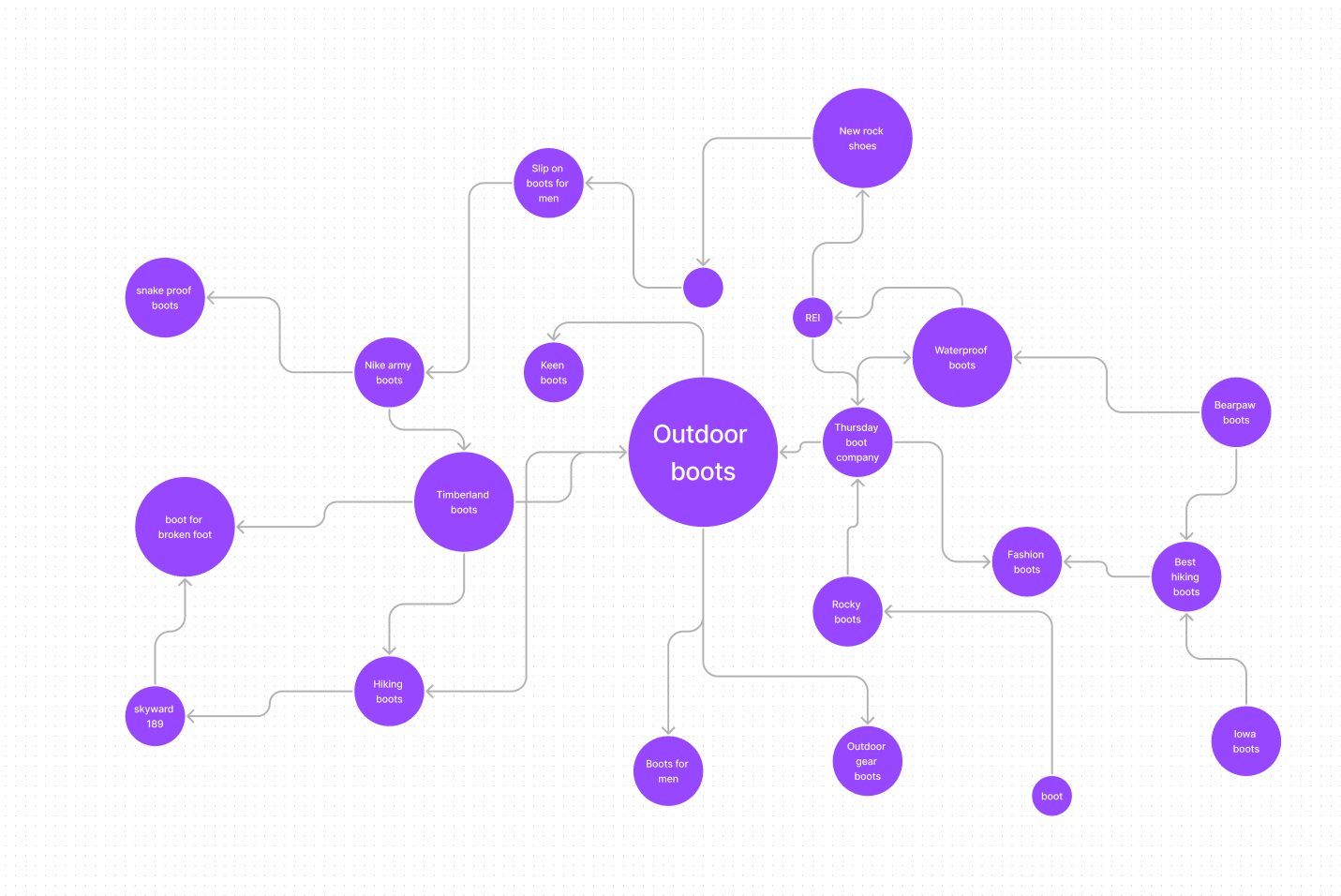
Let’s assume this knowledge graph covers ALL associated keywords from ALL top-performing pages.
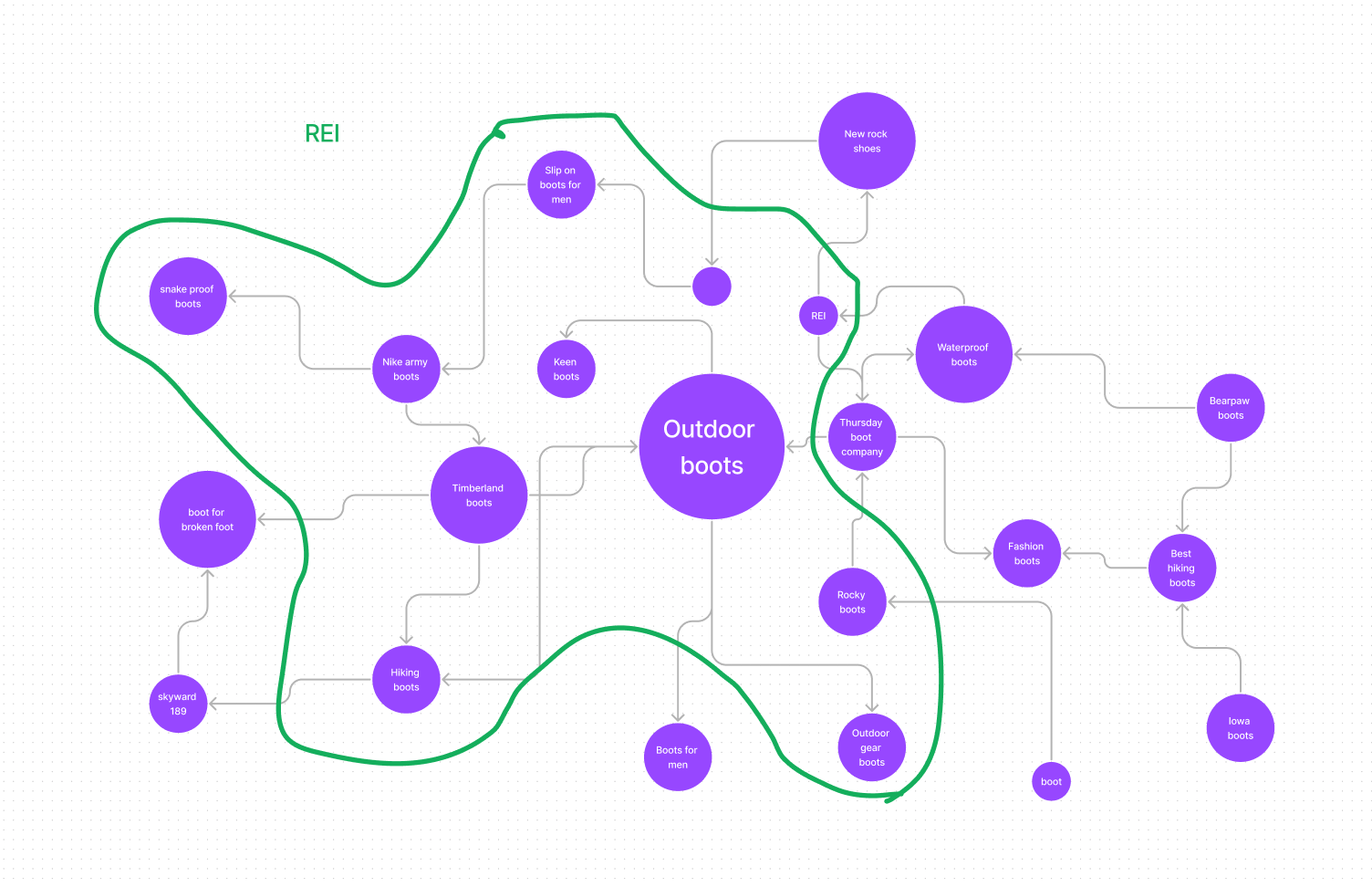
REI’s page is only associated with some of the keywords, circled in green below:
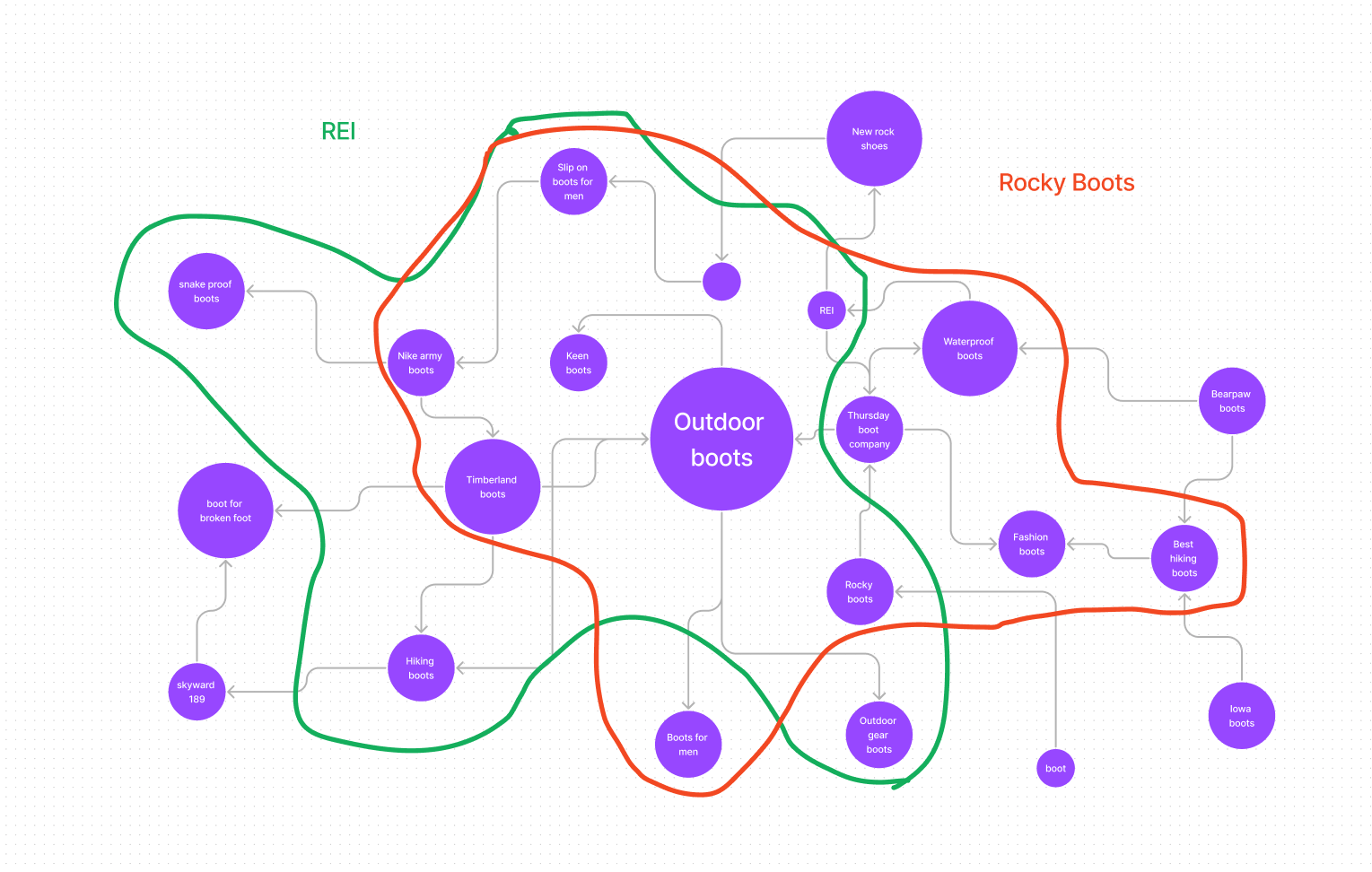
Rocky Boots is ranking #2 for outdoor boots, with slightly different associated keywords:
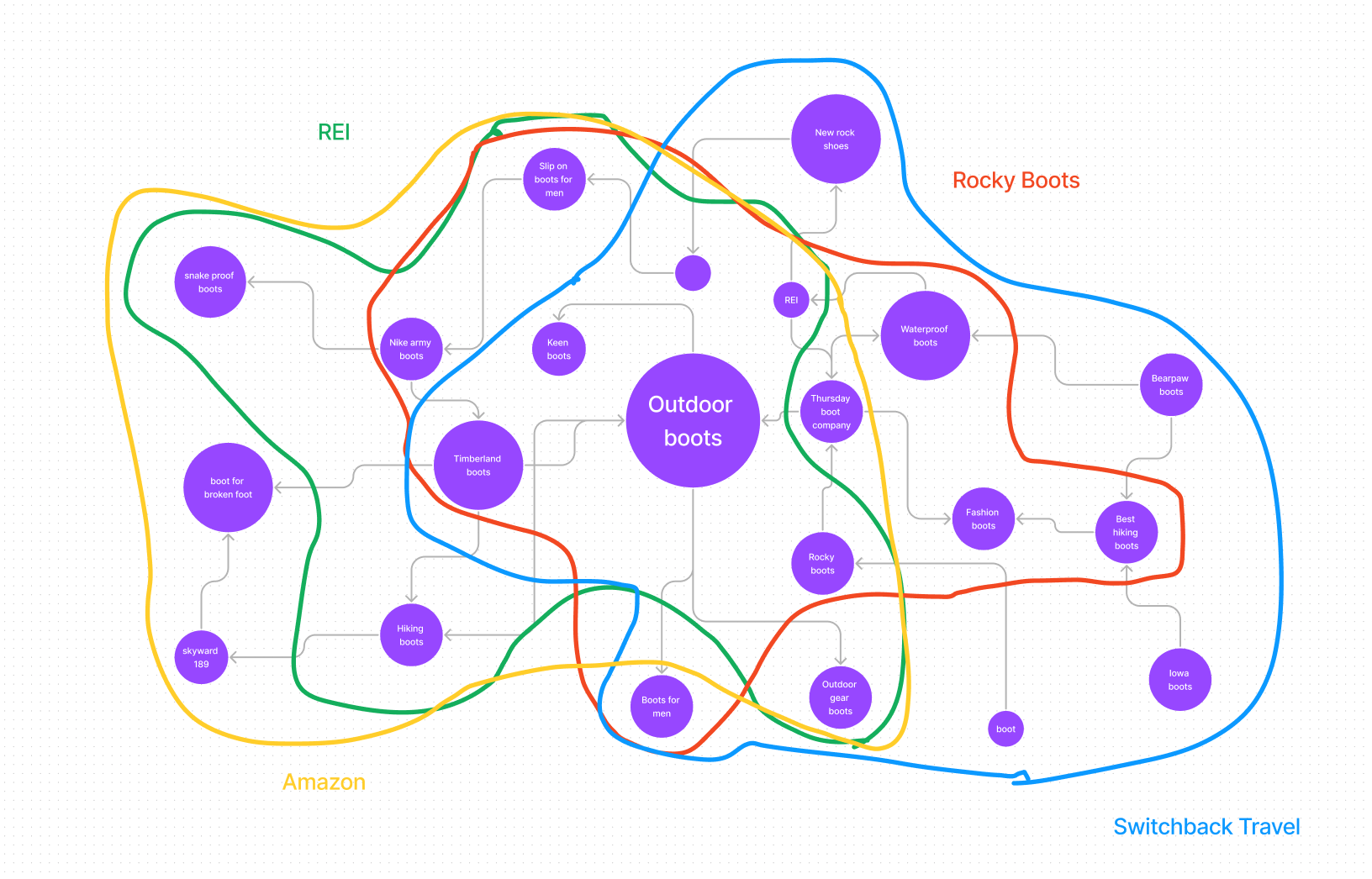
If we map all four top-ranking pages, we could get something like this:
Two important notes here:
- Notice the overlaps
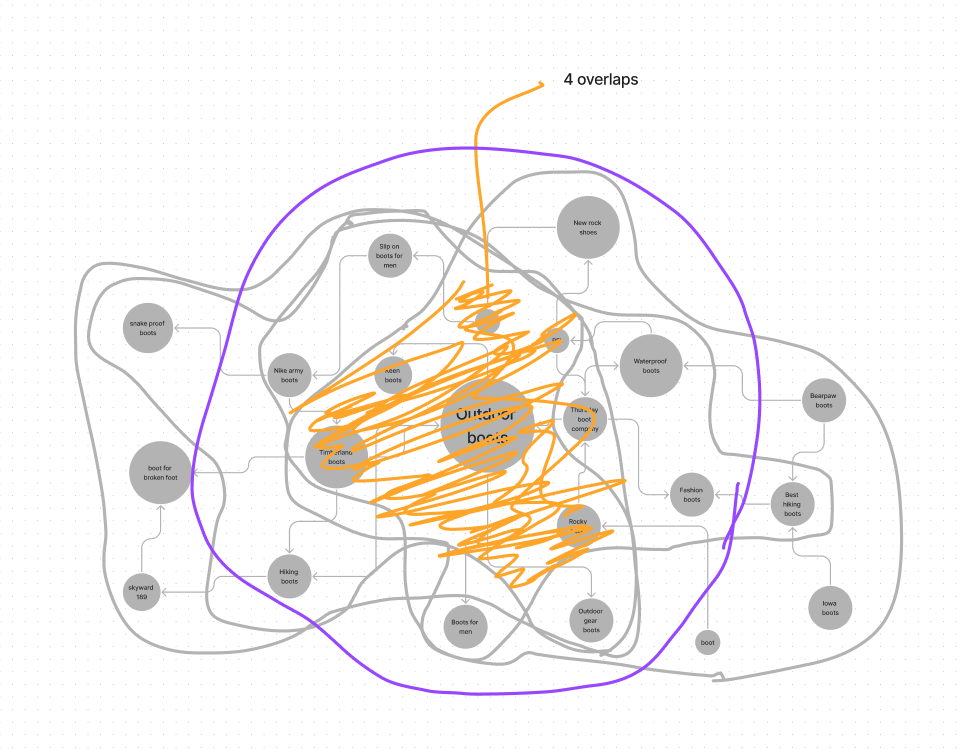
See how ALL four pages are associated with Outdoor boots (because they’re all ranking for the term). We’d call this a “four overlap keyword.” At the same time, only one site is associated with “Iowa boots.” We’d call this a “one overlap keyword.”
- See zones of control
This visualization helps us see how each page has its own “zone of control” in the SERP. All of these pages are ranking for “Outdoor boots”, but they each have different areas of expertise under that umbrella.
Maybe REI is ranking #1 because they have the most topical authority on hiking boots, while Rocky Boots has more expertise in the “heavy duty” outdoor boot space, and Switchback Travel talks about fashion outdoor boots, etc.
If we want to build topical authority for “outdoor boots”, then our goal is to create a zone of control that looks like this:
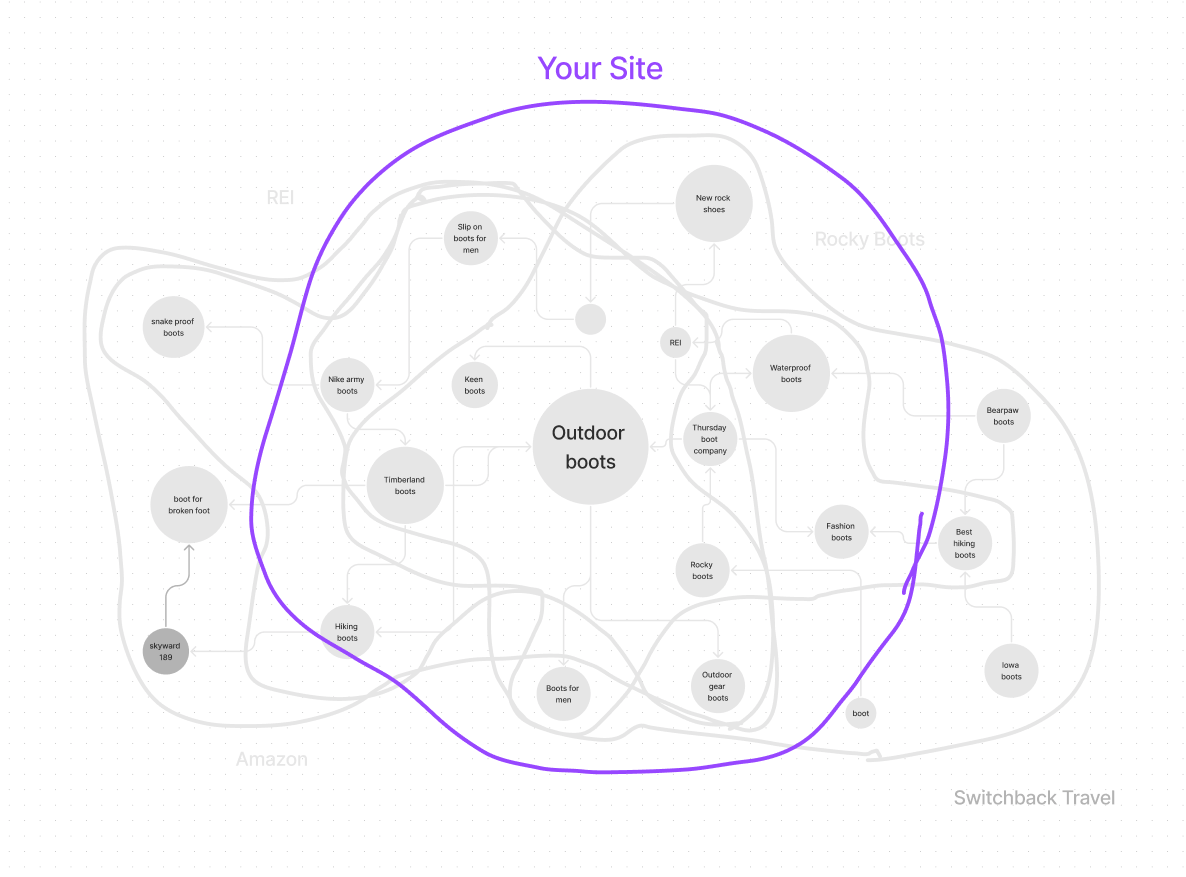
More targeted. More comprehensive. More intentional.
To do that, you have to make sure your site covers:
- All of the most important associated keywords (4 overlap)
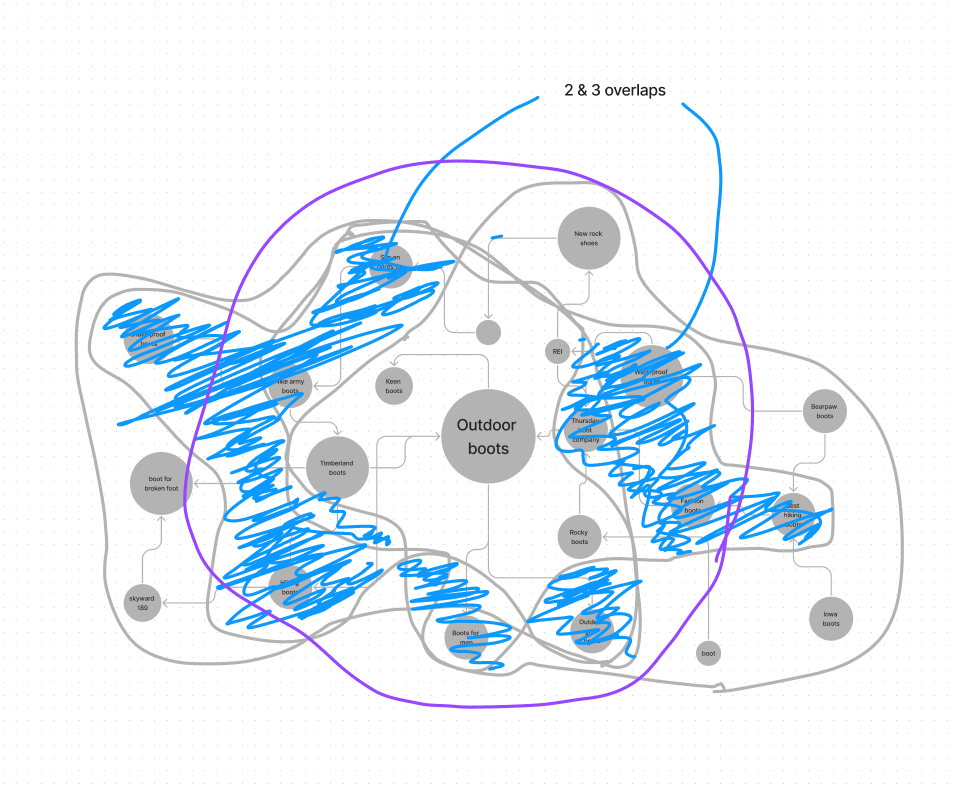
- More of the adjacent topics than any single competitor (two and three overlaps)
- A handful of more loosely related keywords meant to add new, unique information, and show that you know the industry better than anyone else (a mix of 1-overlap keywords and net-new keywords).
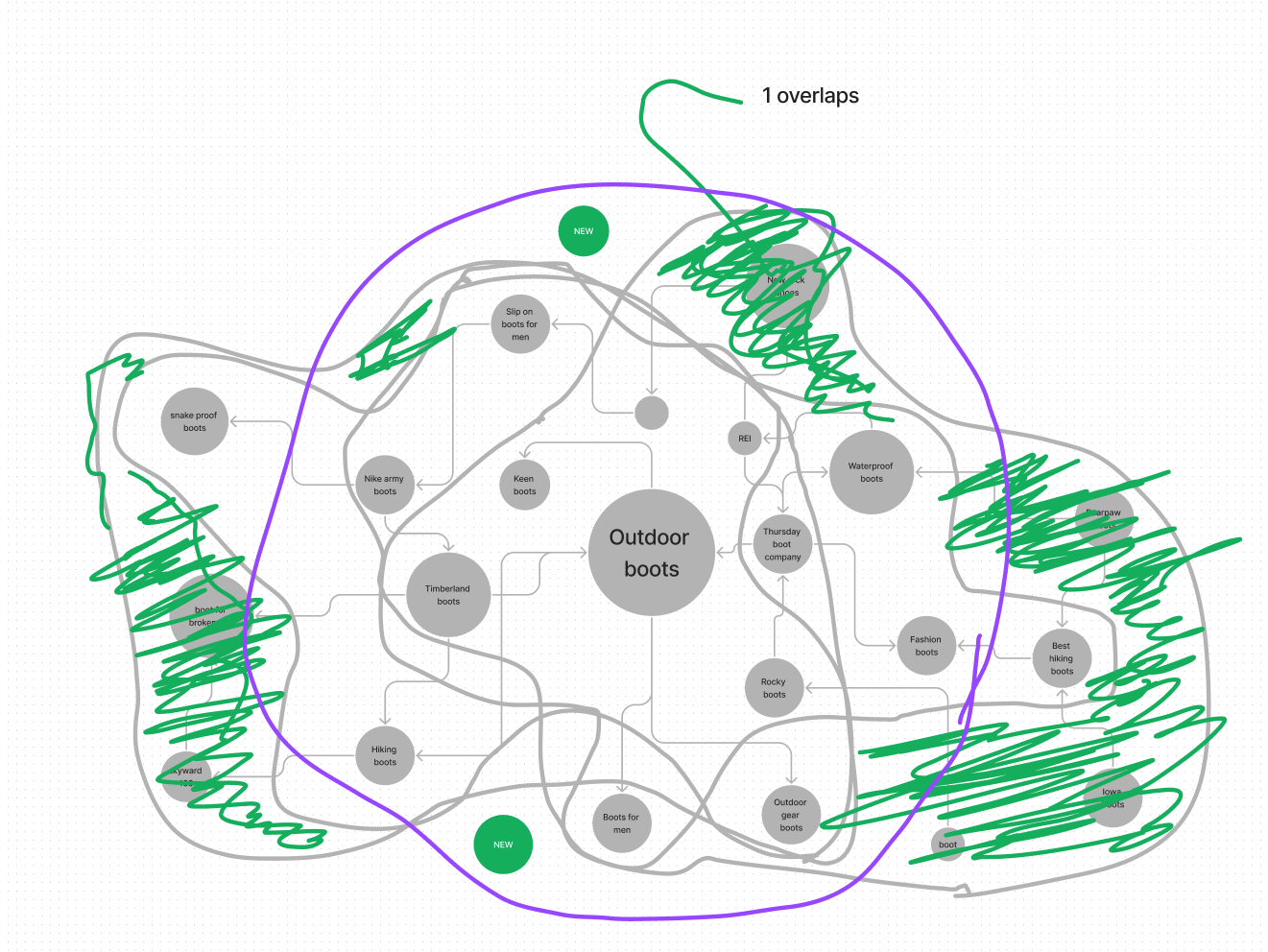
If done correctly, your knowledge graph should be more targeted and comprehensive than any of your competitors, giving you a massive edge. In short, you will have the most topical authority in your space.
(By the way, this image and concept are the reason this method is called Battleground SEO. It's all about mapping the battleground of the SERP and using that intel as a competitive advantage.)
That’s the general concept. Now let’s dig into the tactical execution.
How to Execute Battleground SEO
You will need:
- Google Sheets or excel
- Basic Sheets/Excel formulas
- Ahrefs (you could probably use SEMrush, but I haven’t tried it)
1. Pick Your Seed Keyword
To start the process, pick a short tail keyword that would normally be just outside your reach. If you’re a small company in a competitive space — say home insurance — you’ll have to pick something slightly long tail. E.g. pick “car insurance prices,” not “auto insurance”.
If you’re a giant in your space and can rank for pretty much any keyword you’d like, pick a keyword you’re at position 5-20 for and want to get to #1 (bonus points if you’ve tried to rank higher and haven’t been able to).
If you’re a small company, you’ll have to select a slightly less competitive keyword, but one that still defines an entire sub-niche or sub-category of content. E.g. you could select “insurance pricing” or “homeowner’s catastrophe insurance”, rather than “insurance” or “homeowner’s insurance”.
If you select “insurance pricing” as your seed keyword and follow this process, two things will happen:
- Your rankings for the short tail keyword “insurance pricing” will rise substantially (if you follow the process to the end, #1 rankings are very likely, even with minimal backlink investment).
- You’ll create — and rank — a bunch of content around “insurance pricing” which will also drive more relevant traffic and leads/sales.
The benefit of this process compared to standard topical authority approaches is that you’ll know exactly which topics to write about and how important they are to your overall strategy.
As a final note, I’d make sure the seed keyword you pick is profitable on its own. If you don’t know which keywords are profitable, read this case study.
2. Pull Ranking URLs
Once you’ve selected a seed keyword, Google it, and and paste the URLs from the top five ranking sites into a note for reference.
3. Set Up Content Gap
Third, sign into Ahrefs and enter the first URL into Site Explorer:
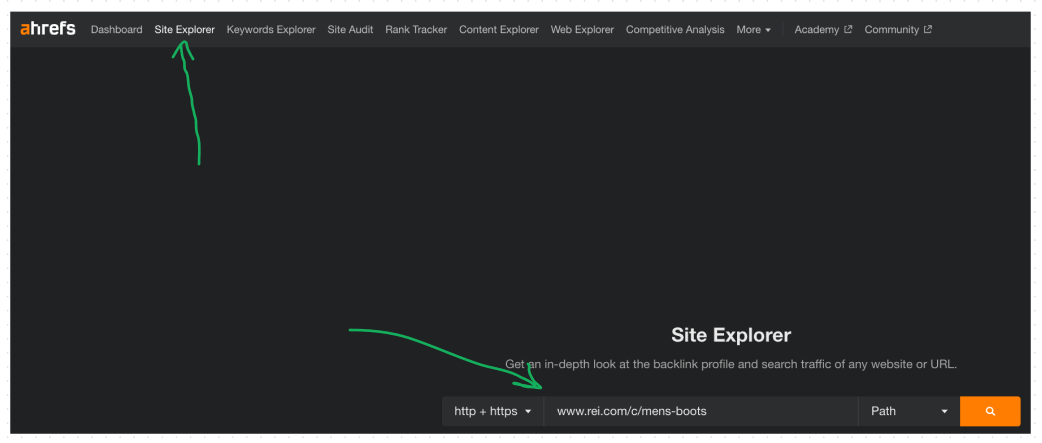
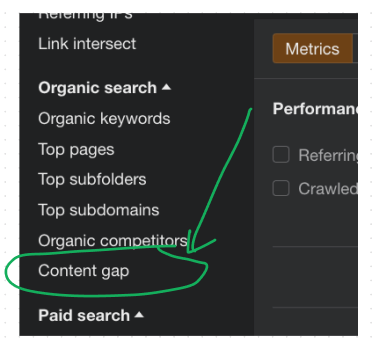
Press search, then click “content gap” on the left:
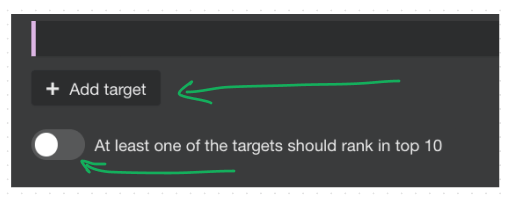
Press “Add target” twice so you have a total of 5 entries. Turn “At least one of the targets should rank in top 10” to the OFF position.
Enter the top five URLs you noted earlier into the comparison. REMOVE the URL from the “But the following target doesn’t rank for” entry at the bottom of the list.
The finished product should look like this:
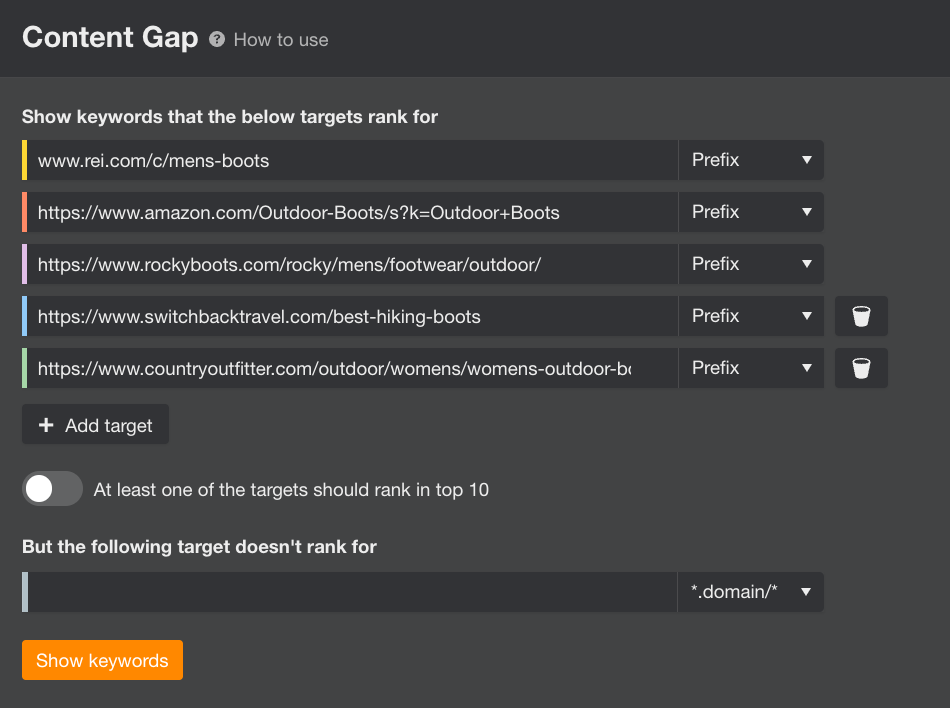
Press “Show Keywords.” When the page loads, export the result as a CSV.
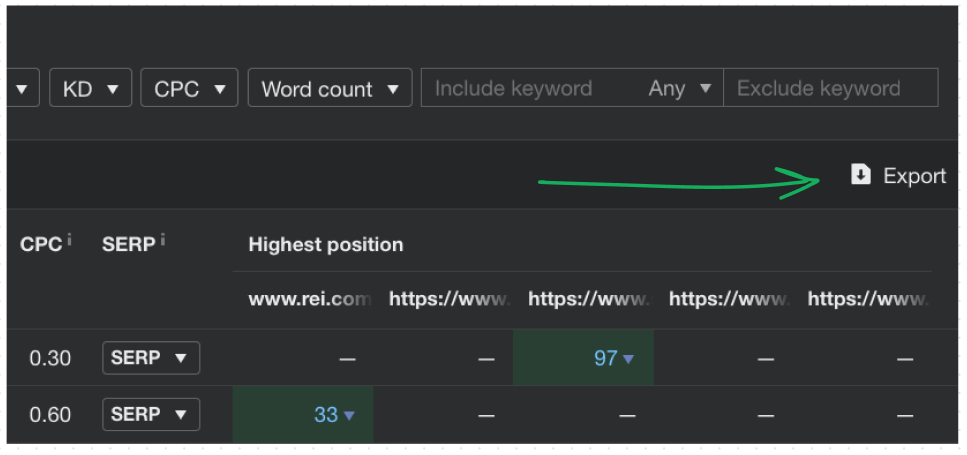
Depending on your plan, the full export may go over your export limit. If so, you can skip it. You’ll also export each overlap individually, it’s just nice to have the full list in one spot so you can get a bird’s eye view of what’s in the knowledge graph for your space.
Next, use the intersection filter and export each group of content individually:
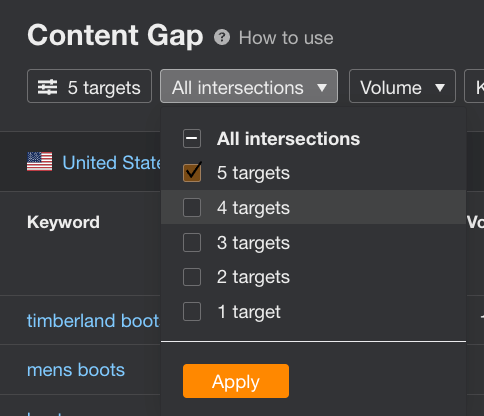
Depending on your plan, you may still run into problems exporting the “1 intersection” set of data (it can get big fast), but you can just export as many rows as you can. It won’t be perfect, but it’ll work.
However, if you can export ALL of the 1-overlap keywords, do so. I’ve had content ranking for 1-overlap keywords drive revenue by themselves, and these often hold some of the most interesting, untapped SEO opportunities.
4. Set up Your Google Sheet
Next, export all of your data into 6 separate sheets, like so:

I’d also recommend adding filters, freezing the top row, and adding alternating colors, but this is optional. Loom showing the process here.
5. Analyze Overlaps
At this point you essentially have a data version of the knowledge graph we reviewed earlier.
It's not uncommon to have tens of thousands of keywords in your sheet. Most of these will be unique to one or two sites. For example, for outdoor boots, the associated keywords break down as follows:
- 5 overlap: 6 keywords
- 4 overlap: 5 keywords
- 3 overlap: 33 keywords
- 2 overlap: 256 keywords
- 1 overlap: 12,234 keywords
This distribution is common. You’ll likely have just a handful of 5 and 4 overlap keywords, with increasing numbers as you go down the list.
6. Assign Keywords to Pages on Your Site
From here your task is to group these associated keywords into new or existing pages on your site. Then, you link those pages back to your target page. Voila! New associations built.
Let’s go through an example:
You look at the associated keywords for “outdoor boots” and find the 5 overlap keywords are as follows:
- outdoor boots
- outdoors boots
- outdoors brand boots
- outdoor boot
- boots outdoor
- boots for outdoors
(Here’s the full spreadsheet so you can follow along)
If you enter each of those keywords into Google individually, they show nearly identical ranking pages compared to “outdoor boots.” In this case, assign all 5 keywords to the page you’d like to rank for “outdoor boots.” You can work them into the page by including them directly, or mentioning a close variant.
Hint: Google each keyword and see what bolded words Google pulls in for each. Use these words or variations to “include” the keyword on your page.
As you get further down the list you’ll encounter more keywords that should be assigned to new pages. In this case, we have a great example in our “3 Overlap” tab:
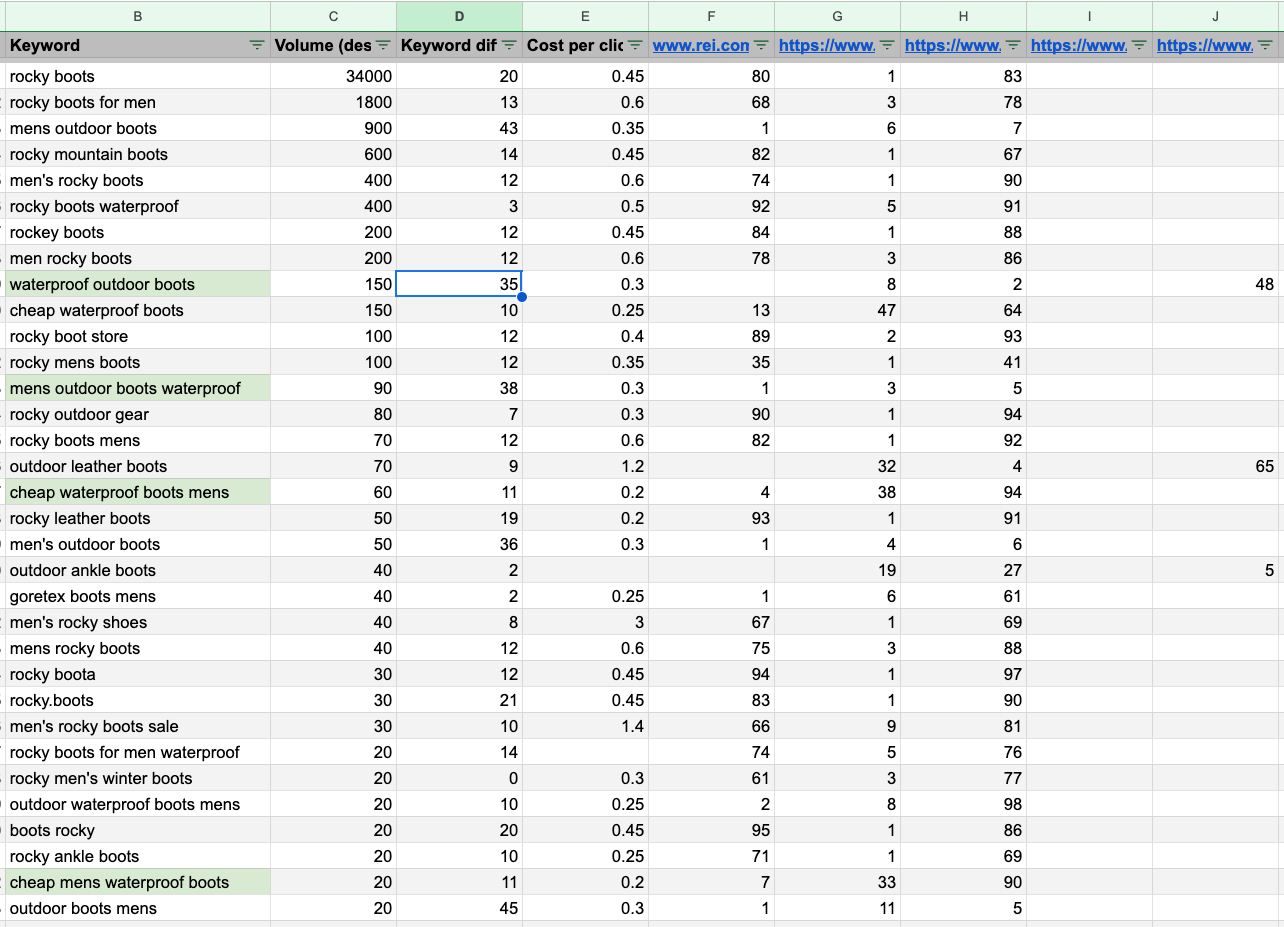
See all the keywords highlighted in green:
- Waterproof outdoor boots
- Mens outdoor boots waterproof
- Cheap waterproof boots mens
- Cheap mens waterproof boots
If you Google “waterproof outdoor boots,” the search results are completely different than those for “outdoor boots.” This makes sense, as “waterproof” is probably the most important modifier in the phrase, and not all outdoor boots are waterproof.
However, the results for “Waterproof outdoor boots,” “mens outdoor boots waterproof” and the other highlighted variations aren’t much different. That means you can assign all those keywords to the same, new page.
By the way, surprise surprise, look who’s ranking #1 for “outdoor waterproof boots:”
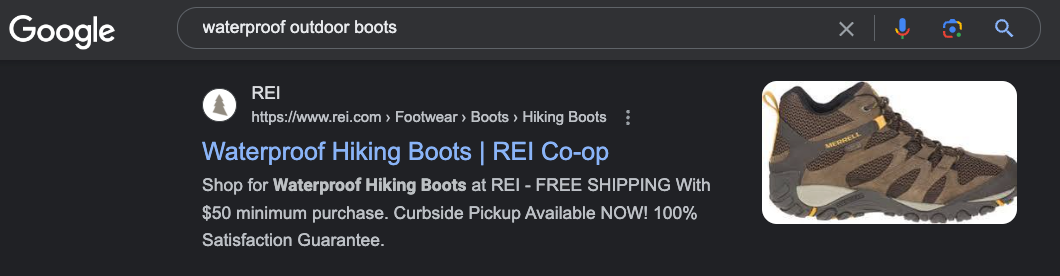
It’s REI — the same site that’s ranking #1 for “outdoor boots” — but with a different page. That’s topical authority at work.
Now, in this case, we have 12,534 keywords to map, and this isn’t even a huge example. I’ve done analyses with five times that amount. This process will take time, no matter how you slice it.
Some SEOs would be tempted to use a keyword clustering tool like keywordinsights.ai to help, but I strongly recommend against doing so, at least for most of the keywords. I’ve tested or used most of these tools and they just aren’t accurate enough to provide the full benefits of Battleground SEO. Here’s what I’d do instead:
Manually review all keywords in the 3, 4, and 5 overlap categories as these are the most important. Even several hundred keywords will only take a few hours to analyze, and that extra effort can have implications for your entire next year of content strategy, so it's worth it.
For 1 and 2 overlap keywords, I don't recommend manual analysis of every single keyword. Instead, I recommend scanning these lists manually and highlighting any keywords that pop out at you. Keep an eye out for keywords that:
- Are related to patterns you saw in the 3, 4, and 5 overlap keywords.
- Are highly relevant to your site
For example, if you see “combat boots for men” in the 1-overlap category…
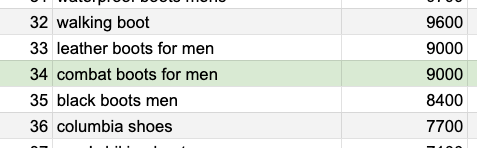
…and just so happen to sell the world’s best combat boots, include that keyword in your process. That’ll help you build your brand and strengthen topical authority at the same time!
7. Filter Your List of Posts
For some industries and keywords you’ll only have a handful of posts to write after step 7. If the list seems manageable, stop there and get to writing. In other industries — especially competitive ones — you could have 100+ posts on your list.
But, just because you have a list of 137 posts, that doesn't mean that you have to write them all. Your competitors certainly haven't.
So, in this step, you go through and trim down the list to only the most important and relevant pieces. Note that by doing so you could negatively impact your topical authority, but you’ll still be ahead of your competitors who haven’t done this process.
Let’s go through a couple of examples.
For “outdoor boots” you’d only have a handful of topics in the 4- and 5-overlap categories, so I’d recommend writing all of them. This won’t always be the case though. I’ve still filtered out posts in the 4 and 5 overlap categories because they target a combined 20-volume, low-intent keyword.
If we skip to the 2-overlap section, we see “best snowboard boots wide feet”, which gets about 20 searches a month. If you don’t sell snowboard boots, I’d likely give this a pass as it’s highly irrelevant and low-volume.
Note that you do see more mentions of snowboard boots in the 1-overlap tab though.
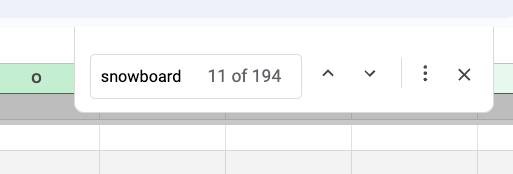
In this case, I might still write one or two posts on the general topic of snowboard boots just to cover the topic. They are technically boots you use outdoors after all 🙂.
Still, that doesn't mean you cut out all low volume or slightly irrelevant posts. Depending on your industry and target keyword that could wipe out most of the keywords.
Instead, here's some rough guidelines to follow
- Five overlap: Keep 80% to 100% of the posts you found.
- Two and three overlap: Keep 50% to 80%.
- One overlap: Keep 1% to 20%.
How To Adjust Battleground SEO for Your Company
If you get to the end of this process and have too much or too little content for your needs, here’s how I would adjust based on the size of your operation:
For Small Content Operations (Post a Few Times a Month)
If you're a small company and run through this process with a super competitive keyword, you might realize you have way more content than you could create in a reasonable amount of time (6 months to a year is a good rule of thumb). If that's the case, I’d recommend picking a less competitive keyword.
Still, you've probably invested several hours into creating this map, so I'd recommend executing on at least part of it. For example, you could just address all the five and four overlap keywords.
For example, “outdoor boots” only had 11 total keywords in the 5 and 4-overlap categories, and all 11 mapped to just two pages. Write those posts, then let them marinate in the SERP while you redo the process for a less competitive keyword.
For Big Publications (Publish Once a Day or More)
If you're a big content operation, meaning you post once a day or more, congrats! You get to run this process once up to once a month.
You can also loosen up the reins on 1-, 2-, and 3-overlap keywords and target more of them. Doing so will help you build a competitive moat, survive algorithm updates, and become untouchable.
For Mid-Size Content Teams (Publishing 8-16 Posts a Month)
In general, we find this process works well out of the box for mid-size content teams, who publish 8 to 16 posts a month. For these teams, running this process once a quarter is about right, especially if you supplement with other content.
For Companies of All Sizes
Regardless of your site's profile, note that this is an iterative process and will still take time to show results. If you write all the content and don't see the exact results you want, wait for an algorithm update — especially a core algorithm update. We find Google is kind to sites who use this system. ;)
Final Tips for Executing Battleground SEO
While this process can help you close massive gaps in authority and beat much larger competitors, it's not magic. If your technical SEO is a mess, you're going to have trouble ranking no matter what you write. And, while backlinks are no longer the end-all-be-all they used to be, they still certainly help.
Before you go consider this:
- From 2000 to 2011 There were 0 algorithm updates related to content
- Since 2011, there have been 43 algorithm updates related to content
- Of the 43, 25 of them have happened since 2020
Content is now more important than ever to compete in SEO, and it will only get more important.
By “content,” I don’t mean content quality which is subjective and hard for a robot algorithm to measure. And I don’t mean content “volume,” since creating content at scale is becoming a commodity with AI.
Now your competitive advantage will come from how you structure your content to work together. The most important part of content as a concept will be “content ecosystem design.” Battleground SEO is one such method of design.
What’s more, I believe Battleground SEO is just the beginning. Other, smarter people will undoubtedly create more sophisticated systems of content ecosystem design as time goes on.
That means that right now, for a brief window in 2024 and 2025, this system represents a temporary — but massive — competitive edge. With it you can outrank your most dreaded competitors, build a moat around your organic presence, and give yourself a head start that will serve you well for years to come. If you're reading this, I urge you to act now. This opportunity won't last forever. CTA for your services?
If you’ve read this far, thank you so much for your time and attention. And if you’d like help implementing Battleground SEO for your site, reach out. It’s what we do every day.
Josh
FAQ:
Will Battleground SEO Require a Lot of Content?
One of the (many) great things about Battleground SEO is its difficulty is proportionate to your industry. If you’re trying to rank for a competitive keyword in a competitive industry like insurance, sales enablement, or CBD, you’ll have to write a lot. If you’re selling Paw Patrol marbles, you might only have to write one or two articles.
If you're expecting a magic wand, this system isn’t for you. If you're struggling to write any content at all, this will not help. If you're already publishing a healthy amount of content and still can’t seem to move the needle, this method will change the game for you.
You have to do ALL of this work just to build topical authority for one keyword. Isn't that unsustainable?
In short, not really.
The first keyword you pick is simply the seed that will build topical authority in an entire area of your business. That’s why you go broad.
By building topical authority for “homeowner’s insurance,” you also build authority for “home insurance pricing,” “roof insurance,” “car and home insurance,” and more. Every time we’ve done this process for clients, we’ve raised rankings across an entire category, not just one URL.
What if I'm a small site in a competitive industry and don’t have the budget for dozens of articles?
Good question. Picking the right keyword will be the most important part of the process for you. If you're a small operation in a big industry, you can start by building a topical authority around a more specific or longtail keyword.
For example, maybe you don't start with “homeowners insurance,” but rather “Texas homeowners insurance,” or “homeowners insurance cost,” or “flood insurance.”
If you run through this process and the output is 120 articles, but you can afford 30, you probably picked the wrong keyword. The point isn’t to target the broadest keyword in your space. The point is to pick a keyword that:
- you know will be profitable (here's how to pick)
- you'd normally consider an unobtainable or reach keyword.
This method is very scalable.
Notes on AEO, SEO, and getting more of your best customers from AI search. No spam.
Member discussion